
Skull Rings Sterling Silver — A 2026 Memento Mori Guide
Key takeaways
- A skull ring in 925 silver is a sculpted memento mori — wearable meditation on mortality.
- The form is centuries old — used by monastic orders, soldiers, masons, mourners.
- Done well: anatomical proportion, deep eye sockets, defined jaw, hand-finished texture.
- Done poorly: cartoon proportions, identical castings, light hollow shells.
- Weight 28–45 g for an architectural skull; daily-wear safe in 925.
- Pairs with brutalist signets — stack one skull, one signet, leave third finger empty.
- STRUGA approach: hand-carved master, lost-wax cast, oxidized recesses, polished high points.
A skull ring in sterling silver is a 925-grade silver ring whose face is sculpted as a human cranium. Worn for centuries as a memento mori — Latin for remember you must die — it is not gothic costume jewellery but a wearable meditation on mortality. Done well, the form is architectural: weight in the hand, hollows that darken over years, edges that record use. STRUGA approaches the genre through its THORN family — skulls as amulets, not trophies.
- Skull rings predate biker culture by 600 years — first in monastic mourning rings (14–15c) and Dutch vanitas paintings (17c).
- 925 sterling silver is the right metal: hard enough to hold detail, soft enough to oxidise, heavy enough to anchor the form on the hand.
- Hollows of the skull deepen with patina over years — light planes stay bright, eye sockets and temple bones go dark. The ring records its wearer.
- STRUGA's THORN family and Brutalism rings and cuffs rings are skull-genre cousins: amulets and architectural objects rather than novelty pieces.
- Choose weight, hand-finish marks, and uncoated 925 over polished mass production — that is where the difference between an object and a costume actually lives.
What does a sterling silver skull ring mean?
A sterling silver skull ring is, at its root, a wearable object of mortality philosophy — shorthand for the awareness that life is finite and the hand wearing the ring is using up its time. The motif sits inside a chain of European art history that runs from medieval monks through 17th-century Dutch still-life painters and lands, in the late 20th century, on rock musicians and bikers. None of these owners invented the skull. They inherited it.
In its serious form the skull ring is closer to a personal philosophical object than to subculture costume. It is not nihilism. It is the older idea that a person who keeps mortality in view tends to make better choices about time, work, and love. Saying it out loud sounds heavy. Wearing it on the hand makes the same statement quietly, in metal.
The other thing it is not: an accessory of fashion churn. A serious skull ring is bought once and worn for ten or twenty years. The form does not date. The patina that accumulates on it does — but in the direction the wearer wants. That permanence is the second reason the genre survives. It refuses the disposable logic of contemporary jewellery; it asks the buyer to commit to a single object and let it become part of the body's vocabulary.
STRUGA's reading of the genre belongs to the architectural side of dark minimalism rather than to outlaw iconography. The closest pieces in our catalogue are not anatomically literal skulls; they are amulets in the THORN family and the heavy, monolithic architectural brutalism rings. The intention is the same — a hand object that asks the wearer to be present — but expressed as form rather than illustration. The argument of this guide is that the more abstract object often does the job better than the literal one, and that what most people are actually looking for when they search for "skull rings" is a piece with the right weight, the right oxidation behaviour, and the right hand-finish — qualities that survive long after the cranium silhouette stops feeling current.
A short history: from memento mori to the silver biker ring
The first wearable skulls in European jewellery appear in the 14th and 15th centuries on Catholic clergy and aristocratic mourners. These rings were small, often enamelled, sometimes inscribed with phrases like respice finem — consider the end. They were not a fashion statement; they were a daily reminder that the body returns to the earth. Surviving examples in museum collections show enamel-filled skulls under domed crystals, miniature coffin-shaped boxes that opened to reveal the same image, and skull-set rings worn by widows on the index finger of the left hand for years after a death.
The 17th-century Dutch and Flemish vanitas tradition turned that idea into still-life painting: skulls placed beside snuffed candles, hourglasses, and rotting fruit. The message was theological and economic at once — wealth ends, time runs, attend to the soul. From that century forward the skull crossed from religious art into Masonic regalia, military insignia (Prussian and later Imperial German cavalry adopted the Totenkopf in the 18th century), and eventually into 19th-century memorial jewellery worn after a death in the family. Victorian mourning rings are the closest direct ancestors of the contemporary sterling silver skull ring: they were heavy, often combined a skull with a lock of hair, and were meant to be worn long after the funeral was over.
The biker silver ring, as Americans recognise it, is a 1960s descendant. Hollywood costume designers borrowed the motif from European mourning rings, scaled it up, and cast it in Mexican-style sterling for outlaw iconography. The Easy Rider aesthetic locked it in. From there it moved across the leather-jacket subcultures of the 1970s and into the heavy-metal and punk visual languages of the 1980s. By the 1990s the skull ring had become a luxury staple through brands like Chrome Hearts in Los Angeles, who repositioned it as gallery-grade silver for collectors and rock musicians; the price point moved from $40 mall-pieces to four-figure hand-finished objects without the iconography itself shifting.
STRUGA enters that lineage from the brutalist end — closer to the European mourning-ring root than to the Hollywood costume layer. The reference points for our heavy rings are concrete public buildings of the 1960s and 1970s and the geometric vocabulary of Russian constructivism, not chopper culture. For deeper context on adjacent design houses, see our guide to brands like Chrome Hearts in affordable dark silver, which maps the contemporary sterling silver skull-ring market against the price points where serious work actually exists.
Why 925 sterling silver is the right metal for skull rings
Sterling silver is 92.5% pure silver alloyed with 7.5% copper. The alloy is the reason the metal works for a sculpted skull: pure silver is too soft to hold sharp detail under daily wear, and the copper content gives the metal enough hardness to keep eye sockets, brow ridges, and temple bones legible after years on the finger.
Three properties matter for this specific object:
- Detail retention. A skull ring is information-dense. The character of the piece lives in 30–40 small features — orbital edges, nasal cavity, occipital curve, jaw line. 925 holds them. Lower-grade silver alloys round them off within months.
- Oxidation behaviour. Silver tarnishes when exposed to sulphur in air, sweat, and water. On a polished band that reads as a flaw. On a sculpted skull it reads as a feature: the deep recesses go dark while the high points stay bright. The object becomes a record of its wearer — a topographical map of where fingers rest, where the ring sits during sleep, where the body sweats most. Read the full logic in our Living Silver patina guide.
- Weight. A serious skull ring is heavy. A piece below 12 grams reads as decorative; one in the 20–35 gram band reads as object. 925 sterling at jewellery-grade density gives that anchoring weight without straying into the medical-implant territory of titanium or the price ceiling of gold.
For a wider treatment of how weight changes how a ring is read, see our silver ring weight guide.
Anatomy of a STRUGA skull ring — process and weight
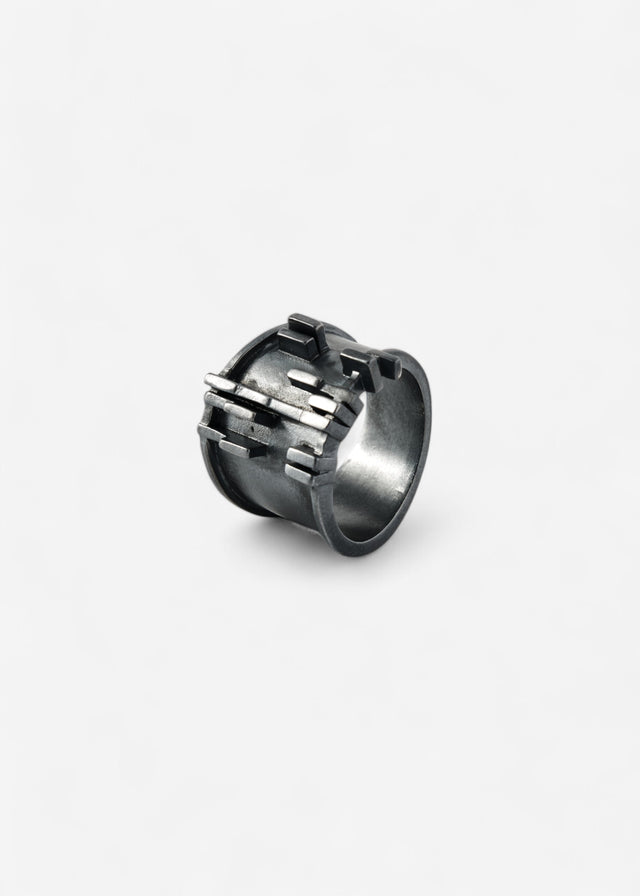
STRUGA does not produce a literally anatomical skull ring. What we produce in the same conceptual neighbourhood are heavy, hand-finished sterling silver rings whose surfaces and weights perform the same job: a ring that pulls attention to the hand, holds a stable place in a stack, and ages visibly with use. The closest analogues are the THORN family and the Brutalism V.1, V.2, V.3 family. The process for both reads the same.
Each piece begins as a model — drawn, sometimes 3D-printed in castable wax, sometimes hand-cut. From the model we make a silicone form. The form holds every detail down to the score marks left by the original. From there it is cast in 925 sterling, then finished by hand. Hand-finishing is where a skull-genre ring lives or dies. We do not buff the metal to mirror brightness; we leave the marks of the file and the burnisher visible. The result is a surface that catches light unevenly, exactly the way a skull's bone surface does.
The mistake mass producers make is to over-finish. A polished skull ring looks like a costume prop because it has too few surfaces for the eye to hold on to. A hand-finished one has dozens of micro-planes — slight asymmetries between the left and right sides of the brow, file marks visible in the temple, planar transitions that catch and release light at different angles as the hand moves. That is what gives the object its presence. It is also what allows the patina to settle into a meaningful pattern rather than a uniform grey film.
Three weight bands are useful when you think about a skull ring as a category:
- Light (10–15 g) — daily wear, layerable in a stack of two or three rings, low intrusion against a keyboard or a coffee cup. This is the band where most beginner buyers should start; it gives time to learn how a skull-genre ring sits in life before committing to a heavier piece.
- Medium (18–28 g) — the standard for a "statement" skull ring; sits as a single anchor on the hand, visible across a room. The Thorn Ring sits at the upper edge of this band — heavy enough to be felt, restrained enough to wear daily.
- Heavy (30–45 g) — sculptural object territory. The Brutalism V.1 Ring and Brutalism V.3 Ring sit in this band. You feel them on your hand the same way you feel a wristwatch — a constant low-grade reminder that something is there. Long-term wearers report that this is the weight at which the ring stops being jewellery and starts being a body object.
For a step-by-step look at how we move from concept to finished silver, see how STRUGA jewellery is made — concept to silver. For the broader weight conversation across all sterling silver rings, see our ring weight guide, which maps how grams translate to perceived presence on the hand.
Materials beyond silver — Carbon and meteorite variants
One of the differentiators in STRUGA's reading of the skull-ring genre is the use of materials beyond plain sterling silver. The brand maintains six proprietary palettes of multi-layered matte carbon fibre — Bloody Graphite, Arctic Graphite, Winter Graphite, Fused Graphite, Toxic Graphite, and Classic Graphite — that combine with 925 silver in specific pieces. Carbon is in the same conceptual orbit as the mortality-imagery tradition: it is a high-performance material that does not corrode, does not patinate, and does not change with use. Pairing it with Living Silver creates a deliberate contrast — the silver that records its wearer beside a black surface that refuses to record anything at all.
The other notable material is Seymchan meteorite — an iron-stone meteorite that fell to earth long before any human jewellery tradition existed. STRUGA uses it as a cross-pendant material in some pieces; the same logic could carry over to a skull ring commissioned through Custom Order. A skull form rendered with a meteorite inset reads as the most literal possible execution of mortality philosophy: stone older than civilisation, embedded in silver finished by a person living now, worn by a third person who will outlive neither.
Skull rings vs signet rings vs amulet rings
Buyers searching for "skull rings" often actually want one of three different objects. The decision is easier when you separate them:
| Type | Function | Visual code | When it fits |
|---|---|---|---|
| Skull ring | Memento mori marker — a personal philosophical object | Sculpted cranium; figurative; high relief | When you want a daily reminder of finitude, expressed as form |
| Signet ring | Identity marker — historically a wax seal, now a personal monogram | Flat or domed face with engraved initials, crest, or symbol | When the message is family, name, or institutional belonging |
| Amulet ring | Protective object — talismanic intent | Often abstract or geometric; sometimes set with a stone | When the meaning is private and abstract rather than figurative |
STRUGA's Thorn Ring sits at the boundary between amulet and skull-genre object — the form is angular and ribbed rather than figurative, but it carries the same hand-presence as a sculpted cranium. For a deeper view on the signet category, see our signet ring meaning and history guide. For the wider men's silver decision-tree, see how to choose a men's silver ring.
Skull motifs across cultures — a comparison
The same silhouette has carried very different meanings across centuries. Three lineages dominate, and a skull ring usually leans toward one of them:
| Tradition | Era | Meaning | Visual signature |
|---|---|---|---|
| Memento mori | 14th–17th century Europe | Reminder of mortality and the brevity of earthly life | Small, often inscribed; restrained; sometimes enamelled |
| Vanitas | 17th-century Dutch and Flemish painting | Wealth ends; attend to higher things | Skull paired with hourglass, candle, fruit, books |
| Biker silver / outlaw | 1960s onward, US-led | Defiance, brotherhood, mortality on the road | Heavy, exaggerated; high-relief Mexican silver lineage |
STRUGA's pieces speak the first language. The reference points are gothic architecture and Soviet brutalism, not chopper imagery. If you are coming from the third tradition and want something quieter, the THORN family and BRUTALISM rings are the closest fit.
About STRUGA. STRUGA is a dark silver jewelry brand founded by Dmitry Strugovshchikov and Ekaterina Strugovshchikova, handcrafted with Balinese and international silversmiths. Every piece is 925 sterling silver, naturally oxidized or hand-patinated. The darkening is part of the design. It is a brutalist object that reacts and changes through contact with the environment and the wearer.