
Signet Ring Meaning and History — Why Men Still Wear Them
Last updated 2 May 2026.
The signet ring is the oldest piece of jewelry men still wear. It started as a tool — a personal seal pressed into wax to authenticate documents — and survived the centuries by becoming the most direct expression of identity a man could carry on his hand. We're not exaggerating. From Mesopotamia in the 4th millennium BCE through Roman law, medieval European inheritance, and into the present, the signet ring has continuously been worn by men. Few categories of human-made object can claim that.
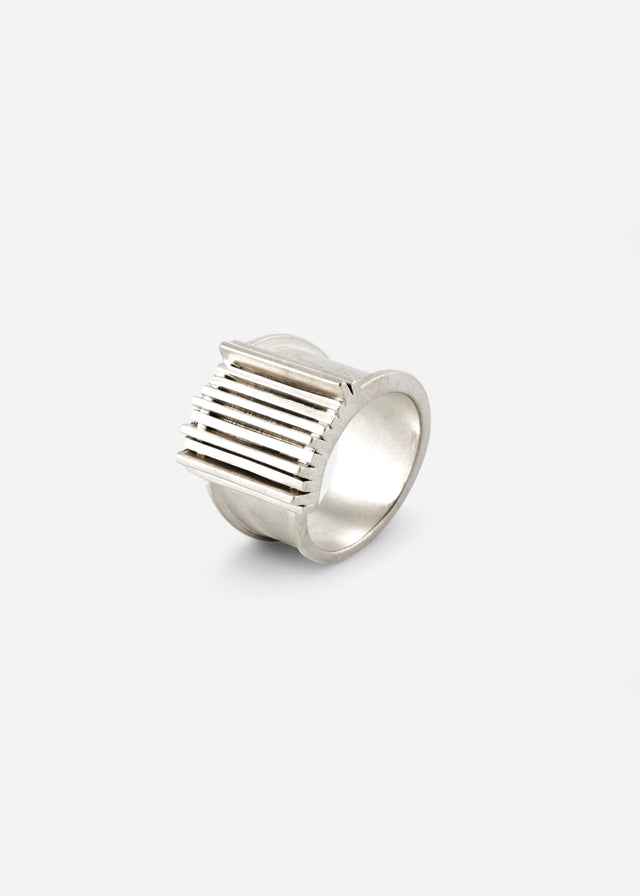
This guide walks through what the signet ring means, where it came from, and why it still works in 2026. Written from the STRUGA workshop where we cast brutalist signet rings — modern interpretations of a 5,000-year-old form.
The form has a long documented history as a personal seal and authentication device — the encyclopaedia entry on the signet ring covers its use from antiquity through the modern era.
Key takeaways
- Signet rings originated as personal seals — pressed into wax or clay to authenticate documents. The flat face is functional in origin, decorative in modern wear.
- Worn by men continuously since at least 3000 BCE. Not a revival trend — an unbroken tradition.
- Modern signet rings serve identity, not authentication. The crest, monogram, or symbol expresses something specific about the wearer.
- The three modern signet styles: classical engraved (initials or crest), modernist plain (no engraving, the form is the statement), brutalist (architectural, often oversized).
Where signet rings come from — a brief history
Ancient origins (3000 BCE – 500 BCE)
The earliest signet rings appear in Mesopotamia and Egypt around 3000 BCE — cylinder seals worn on the finger or strung from a cord, pressed into clay tablets to authenticate documents and mark property. Egyptian pharaohs wore scarab-shaped rings with hieroglyphic seals on the underside.
Greek and Roman period (500 BCE – 500 CE)
Signet rings became standard in Roman daily life. A free Roman man typically owned at least one ring; senators and equestrians had distinctive forms. The intaglio (engraved gem) ring developed during this period — a precious stone carved with a personal device, set into a gold or silver band.
Roman law recognized the signet impression as a valid authentication. A man's seal was effectively his signature. Losing the ring was losing the ability to authorize documents.
Medieval Europe (500 CE – 1500 CE)
Inheritance and heraldry took over. Signet rings became the carriers of family crests, passed from father to eldest son. The ring was used to seal letters with wax — the broken seal proved the letter hadn't been tampered with.
Different regions developed different signet shapes: oval and round for English heraldry, octagonal in parts of central Europe, elongated rectangles in the Iberian peninsula. The shape was sometimes as identifying as the device engraved on it.
Early modern and 19th century
Wax sealing fell out of routine use as gummed envelopes spread in the 1840s. The signet ring transitioned from working tool to symbol of class, profession, or family identity. It was at this point that signets became almost purely decorative.
20th century
Three streams of signet ring tradition continued through the 20th century:
- Aristocratic European — family crest signets passed down through generations.
- American Ivy League / military / fraternal — class rings, regimental signets, lodge rings.
- Working class / trades — initials, patron saint imagery, simpler engravings, gold or silver.
21st century revival
Since the 2010s the signet has come back into the design conversation, with three modern interpretations gaining ground: classical with personal initials, modernist plain (no engraving, just form), and brutalist / sculptural. The brutalist signet is where STRUGA mostly works.
What a signet ring means today
Stripped of its original authentication function, the modern signet means something different. We see it in our customers as one of three things:
Identity carrier
Initials, family monogram, name in symbol form. The ring is a physical attachment of "this is who I am" to the hand. Often inherited or commissioned for an event — a 30th birthday, a graduation, a wedding.
Member's mark
Class ring, military signet, professional fraternal ring (Freemasons, university). Marks belonging to a group. The ring is recognized by other members; outsiders see only the form.
Aesthetic statement
No engraving, no crest. The ring exists as a sculpture on the hand. The blank flat surface is the statement — refusing the traditional content, keeping the traditional form. Most STRUGA signets sit here — heavy oxidized silver, architectural face, no inscription.
The three modern styles
Classical engraved
Polished gold or silver, oval or round flat face, monogram or crest engraved. Worn on the pinky (English tradition) or ring finger of the right hand (continental European tradition). Reads dressy and traditional.
Best for: men with a specific monogram or crest worth carrying. Avoid for: men buying a signet just because it's a category — engraving without meaning is empty.
Modernist plain
Solid silver or gold, geometric face, no engraving. The form is the statement. Often worn on the ring finger or middle finger of either hand.
Best for: men who like the signet shape but don't want explicit content on the face. Reads contemporary and considered.
Brutalist / sculptural
Oxidized silver, architectural face, often asymmetric, kept rough rather than polished. The face is part of the sculpture; the ring exists more as object than as ornament.
Best for: men with a strong personal style, especially those wearing other architectural pieces. Pairs naturally with other brutalism rings and brutalist bracelets.
Which finger to wear it on
Historically: the pinky (small finger). English tradition reserves the pinky for signets specifically because the seal was used by pressing the ring face into wax — the pinky was the easiest finger to twist down for the impression.
Modern wear: any finger, but with conventions:
- Pinky: traditional, English. Reads classical.
- Ring finger, right hand: continental European tradition. Reads dressy.
- Ring finger, left hand: avoid if married — conflicts with the wedding band. If unmarried, fine.
- Middle finger: modern, often used for brutalist or oversized signets where the larger finger supports the ring's visual weight.
- Index finger: rare for signets, more common for statement rings without seal-shape origin.
What to engrave (or not)
If you're commissioning a signet, the engraving question is real. Three reasonable choices:
Personal monogram
Two or three letters, usually first and last initial or first/middle/last. Classical scripts (Roman, English Old English) read traditional; sans-serif reads modern. Reverse-cut (so the wax impression reads correctly) is the historical correct method but mostly unnecessary for modern decorative wear.
Family crest or symbol
Only if you actually have one. Inventing a crest reads false. If your family has a real coat of arms, this is the place for it.
Nothing
The blank face is a statement. It's the modernist position — keeping the traditional form, refusing the traditional content. We make many signets at STRUGA without engraving for exactly this reason. The architecture of the ring carries the meaning.
Sizing a signet ring
Signet rings are heavier than ordinary bands, which means sizing is slightly different:
- Size to the finger you'll wear it on, on a normal-temperature day.
- For pinky-finger signets: the pinky changes size more than other fingers with temperature, so size at room temperature, not after a hot shower or cold morning.
- For wide signets (8+ mm band): size up by half a size from a regular band. Wide bands feel tighter for the same finger size because of the surface area on the skin.
- For brutalist heavy signets: the weight settles the ring lower on the finger over time. Size for daytime fit; the ring will sit slightly looser over the years as the finger flesh adapts.
How to wear a signet ring (and how not to)
Works:
- One signet on one hand, with no other rings on that hand. The signet stands alone.
- Signet on right pinky + plain band on left ring finger (married). Two pieces, two hands.
- Brutalist signet + one or two other brutalist pieces on the same hand for a coordinated stack.
Avoid:
- Signet plus three other decorative rings on the same hand. The signet loses its anchor role.
- Signet face turned inward (hidden). Defeats the purpose — the signet is meant to be visible.
- Engraved signet that doesn't mean anything. Generic "rich-uncle" crests bought from catalog vendors read fake.
Why men still wear signet rings in 2026
Three reasons we hear from our customers:
- Connection to tradition. The signet form has unbroken male wearership for 5,000 years. Wearing one is a small act of joining that line.
- Personal identity in physical form. Initials, crest, or even blank, the ring carries something about the wearer onto the hand. In a world of soft digital identity, a heavy silver ring is concrete.
- Architectural object. The flat-faced ring shape is sculpturally interesting on its own — a small monument on the finger. The brutalist signet leans into this entirely.
Frequently asked questions
What is the meaning of a signet ring?
A signet ring is a ring with a flat or domed face, originally used as a personal seal pressed into wax or clay to authenticate documents. Today it carries identity in symbolic form — initials, family crest, or, in modernist styles, intentional blankness. The form itself signals tradition, identity, and continuity.
Why do men wear signet rings?
Men wear signet rings to carry personal or family identity, to mark belonging to a group (military, university, fraternal), or as a sculptural object on the hand. The signet has been worn by men continuously for 5,000 years across most cultures, making it the oldest continuous form of men's jewelry.
What finger should a man wear a signet ring on?
Traditional English tradition: the pinky (small finger). Continental European tradition: the ring finger of the right hand. Modern wear: any finger, though most men avoid the left ring finger if married. The middle finger works for larger or brutalist signets that need visual weight.
Should a signet ring be engraved?
Only if the engraving means something — your real monogram, a real family crest, a meaningful symbol. Generic engravings or invented crests read false. The modernist position — keeping the signet form without engraving — is increasingly common in 2026.
How much should a real silver signet ring cost?
A solid 925 silver signet from a working workshop costs roughly $200–$600 depending on size, weight, and engraving. Below $100, the ring is usually plated or hollow. Engraved signets in 18k gold start around $1,500 and rise quickly.
Can a man wear a signet ring on his ring finger?
Yes — in continental European tradition, the right hand's ring finger is the standard signet position. The left ring finger is generally avoided by married men because it conflicts with the wedding band, but unmarried men can wear a signet there if they choose.
What's the difference between a signet ring and a class ring?
Class rings are a subset of signet rings — they share the flat-faced form but have specific institutional identity engraved (university name, year, mascot). General signet rings carry personal monograms, family crests, or, in modernist styles, no engraving at all.
Related guides in this cluster
- Men's jewelry style guide
- Should men wear jewelry? Cultural context
- Oxidized silver men's jewelry — care and styling
- Brutalist jewelry for men
- How to layer men's jewelry
Related reading
- Brutalism rings collection
- Dark minimalist rings
- Men's jewelry collection
- 925 sterling silver complete guide
About STRUGA. STRUGA is a dark silver jewelry brand founded by Dmitry Strugovshchikov and Ekaterina Strugovshchikova, handcrafted with Balinese and international silversmiths. Every piece is 925 sterling silver, naturally oxidized or hand-patinated. The darkening is part of the design. It is a brutalist object that reacts and changes through contact with the environment and the wearer.