
The Living Metal: How Sterling Silver Transforms Over Time
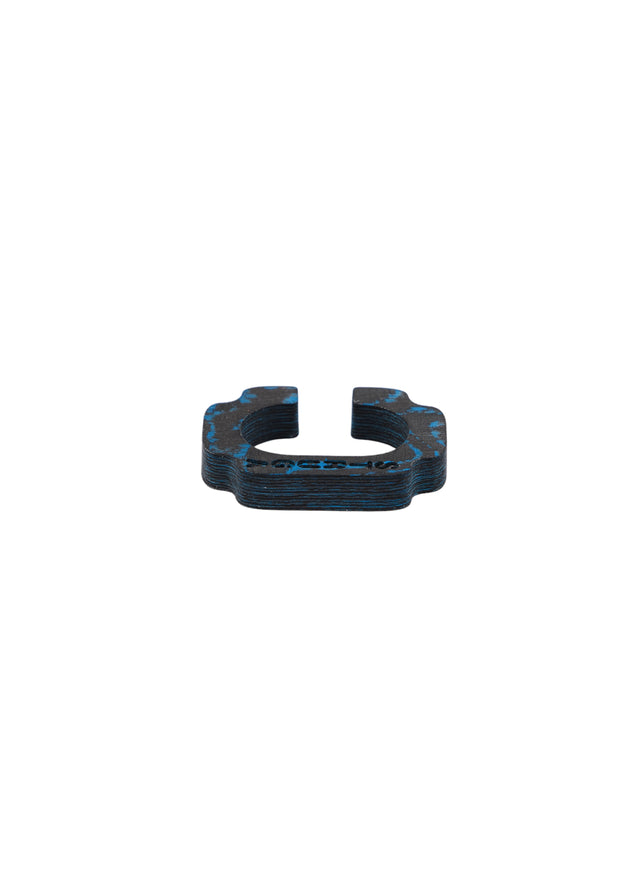
Living Silver is STRUGA's name for what 925 sterling silver does when you stop fighting its chemistry. We don't rhodium-plate our jewelry — the metal stays exposed and reacts with skin, sweat, air, sulfur. The result is patina: a thin layer of silver sulfide that darkens over weeks, lightens on contact points, and makes every piece a personal record of how it's worn. This guide is the complete reference — what patina is chemically, how Living Silver differs from rhodium-plated silver, how patina reads on rings, chains, cuffs, wedding bands, and pieces with carbon or meteorite inlays, and exactly how to care for (or reset) the surface across years of daily wear.
The chemistry behind patina formation in metals.
Key takeaways
- Patina is a chemical surface reaction: silver sulfide (Ag₂S) forms when 925 silver meets sulfur compounds in air, skin, and food. It's a few microns thick, structurally harmless, and entirely reversible.
- Living Silver = no rhodium plating. Most commercial silver jewelry is sealed under rhodium so it stays bright forever (and dies forever). STRUGA leaves the metal alive — it evolves with the wearer. Sterling silver 925 background.
- Two starting points at STRUGA: pre-oxidized pieces (intentionally darkened with liver of sulfur, designs across ritual line and lab line) and bright pieces (designed to develop their own patina, mostly the codex line). Both are valid. The Living Silver philosophy applies equally.
- Material exceptions: carbon-fiber pieces in the Graphite palette don't patina (carbon is colour-stable for decades). Seymchan meteorite develops its own iron oxidation pattern that should be wiped dry after contact with water.
- Wedding bands: Living Silver suits wedding rings exactly because they're worn daily. The patina map becomes a record of the marriage. Full breakdown in our dark wedding rings guide; commissioned through dark union (paired rings).
- Where Living Silver shows up: across all 5 worlds (CODEX, RITUAL, LAB, DARK UNION, ISLAND ARTIFACTS) and 11 design families. Custom Order for bespoke pieces.
What is silver patina, in one paragraph
There's a moment — usually a few weeks after someone buys one of our rings — when we get a message: "My ring is turning dark. Is something wrong?"
Nothing is wrong. Everything is exactly right.
That darkening is silver patina — a natural chemical reaction between sterling silver and the world around it. Air, moisture, the oils on your skin, the food you eat. Chemically it's silver sulfide (Ag₂S), formed when 925 silver meets hydrogen sulfide present in trace amounts in air, sweat, and many foods. The compound is dark; as it forms, the metal shifts from bright white through warm yellow to deep charcoal. It happens to all sterling silver. It's not a defect. It's not dirt. It's the metal doing what metal does.
The word patina comes from the Latin patina — a shallow dish — and over centuries it came to mean any surface change that develops through age and exposure. Bronze gets a green patina. Leather darkens and softens. Wood grains deepen. Silver goes dark. In each case, the patina tells you: this object has lived.
Why does sterling silver turn black?
Sterling silver — 925, meaning 92.5% pure silver and 7.5% copper alloy (full breakdown in our 925 sterling silver guide) — reacts with hydrogen sulfide (H₂S) present in trace amounts in air. The reaction produces silver sulfide on the surface, which appears as a yellow-brown film at first, then deepens to dark grey or black.
Several factors speed up the process.
Humidity and air exposure. Silver in humid environments tarnishes faster. Bali, where one of our production hub is based, sits in tropical air carrying ocean salt — fresh silver can start shifting within days. In dry climates the same piece might stay bright for months. The Bali silver tradition grew up around this fact: silversmiths there have always understood that patina is part of the material's vocabulary.
Skin chemistry. Everyone's body chemistry is different. Your pH, the medications you take, how much you sweat, what you eat — all of it affects how quickly silver darkens against your skin. Some wearers' rings turn dark within a week. For others it takes months. Neither is wrong; both are the same chemistry running at different speeds.
Sulfur-rich environments. Hot springs, volcanic areas, certain foods (eggs, onions), rubber, wool — all contain sulfur compounds that accelerate the reaction. Wearers in Iceland and Japan have told us their rings darkened almost overnight. That's the geology talking.
The copper component. The 7.5% copper in sterling silver also oxidizes, sometimes producing greenish tones — copper oxide, the same compound that gives the Statue of Liberty its colour. On jewelry it usually appears as a subtle warm undertone beneath the silver sulfide layer.
The takeaway: your silver is not degrading. It's recording.
Patina vs tarnish vs oxidation — comparison at a glance
Three terms, three different things. The confusion costs buyers money and forces unnecessary cleaning. The actual differences:
| Aspect | Oxidation (intentional) | Patina (natural) | Tarnish (unwanted) |
|---|---|---|---|
| How it forms | Chemical bath at the workshop — sulfur compounds applied deliberately | Skin contact, sweat, air, time — metal reacts naturally | Air sulfur + humidity over time, no wear interaction |
| Visual | Uniform, controlled black or charcoal at finish | Pulls back along worn surfaces, deep in recesses, alive | Dull yellow-brown to grey film, even across surface |
| Where it lives | Whole piece at point of sale | Recesses, engraved lines, areas you don't touch | Anywhere left untouched in a humid drawer |
| Reversibility | Can be removed with polishing — restored at workshop | Wears with time — pulls off naturally on contact | Removable with silver cloth or polish in seconds |
| Should you 'fix' it? | No — it's part of the design | No — it's the design behaving as intended | Optional — depends on aesthetic preference |
| STRUGA position | Used on most pieces — Living Silver standard | Encouraged — pieces are designed to develop it | Not a defect — clean if you want, leave if you don't |
The Living Silver philosophy treats all three as parts of one system. Oxidation gives the piece its starting register; patina is the metal speaking back; tarnish is just oxidation that hasn't met any wear yet.
Oxidized vs tarnished silver — the working distinction
The two words sound similar but mean different things in workshop language.
Tarnish is the natural, uncontrolled darkening that happens through environmental exposure. It's uneven, gradual, and unique to how you wear and store the piece. Tarnish is what your grandmother's silver spoons develop in a drawer.
Oxidation in the jewelry context is a deliberate, controlled process. A silversmith applies a chemical solution — typically liver of sulfur (potassium polysulfide) — to darken the silver intentionally. The piece is then selectively polished: high points are buffed back to bright silver while recesses stay dark. This creates contrast that highlights texture and detail.
At STRUGA we use both approaches.
Some pieces ship pre-oxidized. Designs with deep textures, carved surfaces, or intricate details — most of RITUAL, much of Thorn and Brutalism, the textured edges in Blade — start their life intentionally darkened. The contrast between dark recesses and polished ridges is part of the design language. We want you to experience the piece that way from the first moment.
Other pieces ship as clean sterling silver. These are designed to develop patina naturally. Most of CODEX ships bright; signature Signature Asymmetric pieces ship bright; smooth Signature Heart bands ship bright. Two identical rings, worn by two different people, will look entirely different after six months. Your ring becomes yours in a way that goes beyond size and fit. The surface becomes a diary of where you've been, what you've touched, how you live.
This is intentional, not neglect.
The Living Silver philosophy — why we don't plate
Most commercial silver jewelry is rhodium-plated. A thin layer of rhodium (a member of the platinum group) is electroplated over the sterling silver. The rhodium is hard, shiny, and inert — the piece looks bright forever, stays bright through any wear, and never patinas. Rhodium is also expensive: in 2026 it sells for roughly twice the price of gold. So manufacturers use the thinnest possible plating, which then chips off at edges within a few years, exposing the silver underneath in mottled patches that look much worse than honest patina ever would.
STRUGA doesn't rhodium-plate. The metal is left exposed, alive, responsive to its wearer. We call this Living Silver: 925 without a coating, evolving day by day instead of frozen in time.
Three reasons we made this choice.
1. Honesty. Plating is cosmetic; it hides the metal underneath. A Living Silver piece shows you what it is — 925 sterling, hand-cast, hand-finished, ageing in real time on your hand.
2. Repair-ability. Plated silver, once the plating wears, has to be re-plated by a specialist with electroplating equipment. Living Silver only ever needs polishing or re-oxidation — operations any silversmith can do in minutes.
3. The personal record. A piece that doesn't change is a piece that doesn't remember. Living Silver carries the wearer's life on its surface. After two years of wear, no one else's ring will look exactly like yours.
The full STRUGA craft process — from wax model through silicone mould, casting, hand finishing, to optional oxidation — is built around the Living Silver assumption. We finish each piece by hand precisely so the patina that develops later has texture to settle into.
How patina reads on different forms
The same Living Silver chemistry shows up differently on rings, chains, cuffs, and pieces with material inlays. Quick guide.
Rings. The fastest patina formers, because they're in constant contact with skin (sweat) and against other fingers (friction). High-contact areas — outer edge of the band, the spot where the ring rests on the next finger when you make a fist — lighten quickly. Recessed details stay dark. Wedding rings (worn 24/7) develop the most pronounced patina maps. Full discussion in our dark wedding rings guide.
Chains. Patina more evenly than rings, because they don't have constant single-point contact. The links closest to skin (back of neck) darken faster than links hanging loose at the front. Heavy Blade chains and Thorn chains develop the most visible contrast over time.
Cuffs and bracelets. Lightening on the inside (skin contact, sweat) and on the highest outer surface (where the cuff meets sleeves and table edges). Recessed work — Brutalism textures, Mosaic seams — stays dark.
Earrings and ear cuffs. Slowest to patina because they have less continuous skin contact and the ear's pH varies less than the hand's. Pre-oxidized pieces are common here so the desired darkness is built in from day one.
Pieces with carbon-fiber inlay. The carbon part doesn't patina — it's a polymer composite, colour-stable for decades. Only the silver around it changes. Over time the contrast between an aged silver frame and an unchanged Graphite carbon panel becomes a defining feature. Read more in the carbon fiber and meteorite materials guide.
Pieces with Seymchan meteorite inlay. The meteorite is iron-nickel and develops its own oxidation if exposed to water — a subtle warm rust tone that some wearers love and others don't. The fix is simple: wipe the meteorite dry after contact with water. The silver part patinas as normal. The Widmanstätten pattern (the etched crystal lattice) stays visible regardless.
Pieces with raw stones (tourmaline, aquamarine, heliodor, natural quartz). Stones are inert; only the silver setting patinas. Black tourmaline pieces are visually compatible with deep silver patina; lighter stones (aquamarine, heliodor) read as a brighter inset against the darkening silver frame.
The meaning of patina — wabi-sabi and the case for ageing
In Japanese aesthetics there's a concept called wabi-sabi — the beauty of imperfection, impermanence, and incompleteness. A cracked teacup repaired with gold. A garden path covered in moss. A blade that shows its age.
Silver patina lives in that same territory.
The first time we worked with silver in Bali, what struck us was the silversmiths' relationship to age. A freshly cast ring and a ring worn for ten years were treated with the same respect. The old one wasn't damaged. It was seasoned. A piece that had lived was, in that culture, more valuable than one that hadn't — not less.
That perspective shaped how we think about material. In a lot of Western jewelry culture there's an instinct to keep everything polished, to fight time. Silver should gleam. Gold should shine. Any change is a problem to solve. We don't work that way.
When someone asks what silver patina means for jewelry, the answer is: it means the piece is alive. The metal is honest. Sterling silver doesn't pretend to be permanent. It wears its history on the surface, and if you let it, it becomes more beautiful — not less — as time passes.
That philosophy runs through everything we design. The dark, minimal aesthetic isn't only a style choice; it's a statement about how objects should age. A STRUGA ring at one month and a STRUGA ring at one year are two different objects, and both are exactly what they should be. Style angle covered separately in our dark fashion jewelry style guide.
How to care for Living Silver — without fighting the patina
Most jewelry-care guides treat tarnish as the enemy. Lemon juice, baking soda, aluminum foil, ultrasonic cleaners — all in service of returning silver to factory-bright condition. If that's what you want, those methods work. But there's a different approach.
Let the patina develop. Wear the piece daily. Let it react to skin. Let high points stay brighter from contact and recesses darken. After a few weeks you'll have a patina that's uniquely yours — a surface no polishing cloth can replicate.
If you want to slow the process, store the silver in a dry, airtight container when not wearing. Anti-tarnish strips (small paper tabs that absorb sulfur from air) help. Keep silver away from rubber, wool, perfume, and lotions.
If you want to reset to bright, a gentle polish with a standard silver polishing cloth removes surface tarnish without damaging the metal. Important caveat: on pre-oxidized pieces, aggressive polishing strips the intentional darkening from the recesses, which changes the design. Buff lightly on the high points only.
If a pre-oxidized piece has lightened more than you want, any silversmith can re-oxidize it in minutes with liver of sulfur. STRUGA does this free for the lifetime of every Dark Union piece (you cover shipping). For other pieces we re-oxidize for a small handling fee.
What we recommend personally. Wear it. Don't overthink it. Silver is one of the most forgiving metals in jewelry. It doesn't corrode. It doesn't weaken from tarnish. Patina is entirely on the surface — a few microns thick — and can always be removed if you change your mind. The best care for sterling silver jewelry is contact with skin. Wear it in the shower (just rinse with fresh water after sea or pool). Wear it to sleep. Wear it every day. The more you wear it, the more it becomes yours.
Living Silver year-by-year timeline — year 1 to year 5
What an oxidised STRUGA piece does over five years of daily wear. Reference point: a freshly oxidised matte black ring, worn 5+ days a week, no aggressive polishing.
- Months 1–3. Oxidation reads uniformly. First contact-point lightening visible at knuckles and inside of bands. Surface still feels matte.
- Months 4–12. Distinct patina personality emerges. Recesses stay black; raised areas pull toward warm grey. Each piece begins to look different from the day it shipped.
- Year 2. Mid-stage. Patina map is now stable — the piece carries the wear of two years of life. Most owners describe this as the moment the piece becomes 'theirs'.
- Year 3. Hand-polished surfaces (rings, bracelets) develop a soft sheen on contact areas. Oxidation in protected zones holds — the contrast is the visual signature.
- Year 4–5. The piece is now a record of how it has been worn. Two identical STRUGA rings worn by two people will read different. This is the design intent of Living Silver.
If you ever want to reset the piece — full re-oxidation back to year-zero appearance — that's a 30-minute workshop service. Most STRUGA owners don't. The patina is the point.
Five-year timeline — what to expect
Months 0–3: peak brightness or peak darkness depending on starting point. Almost no visible change. Patina hasn't started moving.
Months 3–12: first signs of high-contact wear or first development of natural patina. The change is slow and even.
Years 1–2: the patina map develops. Specific zones lighten or darken further. The contrast becomes a defining feature. By the end of year two the ring no longer looks like the day-one piece — it looks like your ring.
Years 3–5: the patina stabilizes. New high-contact areas continue to lighten gradually; existing patterns don't reverse. If at any point the change goes further than you want, a quick reset (re-oxidation or polish) returns the piece to year-zero conditions, and the cycle starts over.
How to care for Living Silver — 5 steps that work with the patina, not against it
The principle: clean only what you want gone. Most owners over-clean and erase the patina they paid for. Here is the working method:
- Daily — wear it. The single best 'maintenance' is wearing the piece. Skin contact moves oxidation along intended paths. Pieces that sit in drawers tarnish unevenly.
- Weekly — soft dry cloth. Wipe contact surfaces with a clean dry cotton cloth. Removes loose tarnish and skin oils without touching the patina.
- Monthly — warm water + mild soap. Soak for 5 minutes, rinse, pat dry. Cleans away salt and product residue without chemistry strong enough to disturb oxidation.
- Quarterly — silver-polish cloth (selective). Use only on areas you want bright — high points of a ring, the front of a pendant. Never on engraved lines or inside band recesses, where patina belongs.
- Avoid always — ultrasonic cleaners and dip solutions. Both strip oxidation completely. They turn Living Silver into ordinary polished silver in a single pass. If you ever need this level of clean, send the piece back to the workshop for proper re-oxidation.
Where Living Silver fits in the dark silver landscape
The choice not to rhodium-plate places STRUGA in a small group of brands that take patina seriously. Chrome Hearts, Parts of Four, Werkstatt:München, Bill Wall Leather — most of the serious dark silver makers leave the metal to live. Mass-market brands almost universally plate. Our brands like Chrome Hearts guide covers the wider landscape and explains where each major maker sits on this spectrum.
If you're drawn to dark silver, you probably already understand intuitively what Living Silver is about. You're not looking for something that stays the same. You're looking for something that changes with you.
FAQ
Is silver patina desirable?
Yes — for many wearers it is the point of the piece. Patina records the wear of the silver: where the hand rubs, where the chain falls against skin, where time accumulates. The recessed darkening contrasts against polished raised surfaces, creating depth no factory finish can match. STRUGA's Living Silver philosophy treats patina as the metal's natural aged state.
How to quickly patina silver?
Wear the piece constantly, especially during exercise — sweat accelerates the silver-sulfide reaction. For controlled in-workshop patina, jewelers use liver of sulfur (potassium sulfide) solution: a brief dip darkens silver in seconds, then high points are polished back to leave the recesses oxidized. Both methods produce the same chemistry; wear-patina is more durable.
Can you fix silver patina?
Yes — patina is fully reversible. A polishing cloth removes light tarnish in minutes; deeper patina dissolves with silver-cleaning dip or fine pumice and water. Many wearers prefer to keep partial patina — polishing high points while leaving recesses dark — which is also how oxidized finishes are originally created in the workshop.
What is the difference between patina and tarnish?
Same chemical reaction, different framing. Tarnish describes the surface darkening as a fault to be removed; patina describes it as a desirable aged finish. Both are silver sulfide forming on the metal surface. The difference is intent: jewelers who polish call it tarnish, those who embrace the aged look call it patina.
Does silver patina damage the metal?
No. Patina is a surface reaction — silver sulfide forms a layer only a few microns thick. The structural integrity of the silver is completely unaffected. The patina can always be removed, returning the piece to bright silver. The metal beneath has not corroded or thinned.
Is oxidized silver jewelry safe to wear daily?
Yes. The oxidation layer is the same silver sulfide compound that forms naturally — chemically stable, non-toxic, durable through years of daily wear. Oxidation does not transfer to skin or clothing under normal conditions, and the layer protects the metal beneath rather than degrading it.
Does Living Silver work for wedding rings worn 24/7?
Yes — wedding rings are exactly where Living Silver makes the most sense, because they're worn through every shower, every workout, every year. The patina records the marriage in the metal. Rhodium-plated wedding rings have to be re-plated every few years; uncoated 925 simply ages with the wearer.
The living metal
We named this guide The Living Metal because that's how silver behaves after years of working with it.
Every ring that leaves our workshop is the beginning of something, not the end. The metal will shift, darken, warm, and settle into a surface that reflects the person wearing it. Two people buying the same design will end up with two different objects. That isn't a flaw in the material — it's the entire appeal.
If you keep things wrapped in cloth, protected from air and touch, sterling silver might frustrate you. If you wear your jewelry into the ocean, sleep in your rings, and don't mind a few marks, you'll find that silver patina is one of the most satisfying things in material culture.
The metal remembers. Let it.
Explore the STRUGA collection — from signature CODEX links to spiritual RITUAL pieces and experimental LAB objects, every piece is hand-cast in Bali (or ) from 925 sterling silver, designed to age with character. Looking for something personal? Browse Custom Order for any single bespoke piece, or Dark Union for paired wedding and engagement rings.
About STRUGA. STRUGA is a dark silver jewelry brand founded by Dmitry Strugovshchikov and Ekaterina Strugovshchikova, handcrafted with Balinese and international silversmiths. Every piece is 925 sterling silver, naturally oxidized or hand-patinated. The darkening is part of the design. It is a brutalist object that reacts and changes through contact with the environment and the wearer.
Continue from STRUGA catalog: