
Unique Men's Wedding Bands 2026 — Dark Silver Guide
Key takeaways
- A unique men's wedding band earns its place over decades — material, weight, form.
- Three axes: metal (silver / steel / titanium), weight (12–28 g), form (signet / cuff / band).
- Sterling silver in dark finish ages with the hand — patina becomes the ring's biography.
- Width 6–10 mm, weight 18–28 g for a daily-wear architectural band.
- Avoid plated finishes — the plate wears through in 2–4 years on an active hand.
- STRUGA Dark Union bands: hand-cast 925, oxidized matte, no inlay tricks, no factory polish.
- Custom path: choose width, weight, finish, optional inner engraving — ~3 weeks lead time.
A unique men's wedding band in 2026 means a ring that earns its place over decades — material that ages with the hand, weight you feel without thinking, and a form that does not date. Three axes separate the genuinely unique from the merely different: the metal (sterling silver, carbon, meteorite over the tungsten and titanium defaults), the finish (hand-marked surfaces over machine polish), and the story (a piece you would still wear at sixty). STRUGA reads the category from the architectural side of dark minimalism — engineered for forty years on the same finger, not for the ceremony alone.
- Most "unique" men's wedding bands sold online are tungsten or titanium plus a black PVD coating — a coating that wears off in five to ten years and cannot be repaired.
- Sterling silver 925 (92.5% silver, 7.5% copper) is heavier, resizable, hand-finishable, and develops Living Silver patina that records the marriage rather than concealing wear.
- STRUGA's three signature directions for wedding bands — architectural Signature Asymmetric family linked bands, brutalist BRUTALISM blocks, and Carbon-silver hybrids from the Carbon family — sit outside the tungsten/titanium/gold default.
- For a ceremonial piece carrying genuine material story, Seymchan iron-stone meteorite from the FUSED family is older than civilisation and pairs with 925 silver in custom Dark Union commissions.
- The right weight for a forever band is 6 to 14 grams in silver — heavy enough to register on the hand without becoming an obstacle. Width 5 to 8 mm depending on hand size.
- A daily-worn dark silver wedding band needs about five minutes of care a year — no plating to refresh, no coating to repair, no professional servicing.
What makes a men's wedding band genuinely unique in 2026?
Three axes separate a wedding band that stands apart from the cookie-cutter market: material, finish, and story. None of them is about looking unusual on the day of the ceremony. They are all about the next forty years.
Material honesty. Most wedding bands marketed as "unique" or "alternative" in 2026 are tungsten carbide or titanium with a PVD coating layered on top. PVD — physical vapour deposition — is a surface treatment two to five microns thick. It is dense, scratch-resistant on day one, and looks identical to genuinely blackened metal. It also wears off: manufacturer warranties typically cover seven to ten years, real-world coating loss begins at year three to five at the contact points. When the coating fails, the bare silver-grey metal underneath shows through. The coating cannot be re-applied at a normal jeweller. A genuinely dark band has the colour in the alloy itself or in a controlled oxidation that reaches into the metal — not above it.
Finish. Mass-produced bands come off CNC lathes with a uniform mirror or matte finish that reads as dimensionless under light. A hand-finished band has dozens of micro-planes — slight asymmetries, file marks left visible, planar transitions that catch light at different angles as the hand moves. A polished tungsten band looks like a polished tungsten band from any angle. A hand-finished sterling silver band looks different under a kitchen LED than under afternoon window light, different on a wet hand than on a dry one. That variation is what gives the object its presence over years.
Story. The story can be about the metal — 925 silver alloy in continuous use across European jewellery for nine centuries, an iron-stone meteorite that fell to earth before the human jewellery tradition existed. It can be about the maker — a hand-finished piece traceable to a specific small workshop versus a SKU pulled from a shipping container. It can be about the form — an architectural language tied to a specific design lineage rather than a generic wedding silhouette. The story has to be true; "rare meteorite" with no documented fall site or chemistry test is the marketing version, not the material version.
STRUGA reads the wedding band category from the architectural end of dark minimalism. The reference points are gothic stone buildings and Russian constructivism rather than brand wedding catalogues. Pieces are made by hand in small workshops on Bali and in Russia (Stavropol), with single-maker responsibility per piece. For couples who want the same logic applied to a custom-designed pair, the brand operates a dedicated wedding service, Dark Union; for individual pieces outside the wedding catalogue, Custom Order.
Material spectrum: silver, gold, platinum, titanium, tungsten, carbon
The six metals that dominate the men's wedding band market in 2026 are not equivalent. Each has a different weight on the hand, a different lifespan, a different repair pathway, and a different relationship with daily wear. The decision between them is the largest single choice in the buying process — larger than width, larger than finish, larger than price band.
Sterling silver 925 is 92.5% pure silver alloyed with 7.5% copper. The density is 10.36 g/cm³; the Mohs hardness is around 2.5 to 3 in the alloy state, lower than gold but high enough to hold form under daily wear. The metal can be resized at any competent jeweller, can be hand-finished to mark or unmark surfaces, and develops the oxidation behaviour STRUGA calls Living Silver — a feature on a wedding band rather than a defect. Lifespan with reasonable care is multi-generational; sterling silver wedding bands from the 19th century still circulate in working condition.
Yellow gold 18-karat is 75% pure gold with the balance copper and silver. Density 15.6 g/cm³, Mohs hardness around 2.5. White gold of the same karat is 75% gold alloyed with palladium or nickel and typically rhodium-plated to reach the cool tone the buyer thinks they are buying; the rhodium plating wears off in two to four years and needs renewal. Platinum is 95% pure with 5% iridium or ruthenium, density 21.45 g/cm³ — almost twice the heft of silver — and a hardness around 4 to 4.5. Both gold and platinum can be resized; both are repairable; both carry the cost premium that comes from being precious-metal commodities priced by spot market.
Titanium grade 4 (ASTM B348) is commercially pure titanium, density 4.51 g/cm³, hardness around 6 on the Mohs scale and approximately 200 HV (Vickers). It is light — about 44% the weight of silver in the same volume — and corrosion-resistant. It cannot be resized in any normal sense; any change in inner diameter requires re-cutting from new material. It cannot be soldered with standard jeweller's torches. Cracks cannot be repaired. Tungsten carbide is harder still, around 8.5 to 9 on Mohs and 1500 to 1800 Vickers, density 14.5 to 15.6 g/cm³ depending on cobalt binder content. It is functionally unscratchable in daily wear but it is also brittle; a sharp impact at the wrong angle can fracture a tungsten band cleanly through. Tungsten cannot be resized at all and cannot be repaired.
Carbon fibre composites used in jewellery are not the carbon fibre used in aerospace structural components. They are layered carbon fibre cloth set in epoxy or polymer resin, then cured and machined. Density runs 1.5 to 1.8 g/cm³, lower than aluminium. Hardness varies with the resin matrix; the surface is generally harder than silver and softer than tungsten. Carbon does not corrode, does not patinate, does not change colour with use. It is a stable surface that pairs well as a contrast element against silver in the same band. STRUGA produces Carbon under six proprietary palettes — Bloody Graphite, Arctic Graphite, Winter Graphite, Fused Graphite, Toxic Graphite, and Classic Graphite — used in Carbon family pieces.
The full comparison reads as follows.
| Material | Density (g/cm³) | Hardness (Mohs) | Resizable | Repair pathway | Honest lifespan |
|---|---|---|---|---|---|
| Sterling silver 925 | 10.36 | 2.5–3 | Yes (any jeweller) | Solder, refinish, re-form | Multi-generational |
| 18k yellow gold | 15.6 | 2.5 | Yes | Solder, refinish | Multi-generational |
| Platinum 950 | 21.45 | 4–4.5 | Yes (specialist) | Laser-weld, refinish | Multi-generational |
| Titanium G4 | 4.51 | ~6 (200 HV) | No, in practice | Replace if damaged | 10–20 years |
| Tungsten carbide | 14.5–15.6 | 8.5–9 (~1700 HV) | No | None — replace | Until impact-fractured |
| Carbon fibre composite | 1.5–1.8 | ~3.5–4 | No | None — replace | 15–25 years |
| PVD-coated tungsten/titanium | As base | As base | No | Coating not re-applicable | 5–10 years (coating) |
The metals separate into two cohorts on the question that matters most for a wedding band. Silver, gold, and platinum are repairable, resizable, and effectively permanent. Titanium, tungsten, and carbon composites are durable in their first decade and disposable thereafter. Coated bands occupy the worst position: high upfront cost, finite cosmetic lifespan, no repair pathway. For a ring intended to mark a forty-year decision, the first cohort is the only honest choice; within it, silver gives by far the most freedom of form at the lowest material premium, which is why STRUGA's wedding work concentrates there.
For a deeper read on the silver-versus-gold question specifically, see silver wedding rings versus gold. For the broader dark wedding band conversation including stone-set pieces and matte oxidised finishes, see the dark wedding rings guide.
STRUGA's three signature directions for a wedding band
The brand's catalogue does not include a "wedding band" category in the conventional sense — there is no plain comfort-fit half-round in five widths. What it does include are three families of rings that men have been buying as wedding bands since the brand launched, and which the Dark Union service can adapt for couples who want a matched pair. Each direction reads the wedding band problem from a different angle.
Direction one — architectural Signature Asymmetric
The first form of the brand. Signature Asymmetric began as a pendant silhouette and migrated into rings as a linked-band geometry: square-section silver elements joined into a ring that adjusts in size by reshaping the linkage. The visual reference is industrial — a fragment of structural steelwork rather than a smoothed wedding silhouette. Signature Links Ring V.1 and V.2 both belong to this language, as does the Double Line Links Ring for a paired-line variant. For a wedding context, the linked-band form lets a couple commission matched-but-not-identical rings — same vocabulary, different proportion, traceable to the same geometric rule rather than to factory tolerance.
Direction two — BRUTALISM blocks
The brand's heaviest, most monolithic ring family, developed in collaboration with an architect as a tribute to Soviet brutalist concrete buildings. BRUTALISM V.1 Ring and V.3 Ring both sit in the 25 to 40 gram band — substantially heavier than a conventional wedding ring, which is the point. The piece announces itself on the hand without ornament. Couples who want their wedding bands to function as anchor objects rather than understated bands choose this direction. The variations V.1 / V.2 / V.3 run in parallel — they are not iterations of a single design, but separate variations within the brutalism family, the same way an architectural studio holds three completed projects at once. For a deeper introduction to the family, see the BRUTALISM collection.
Direction three — Carbon-silver hybrids
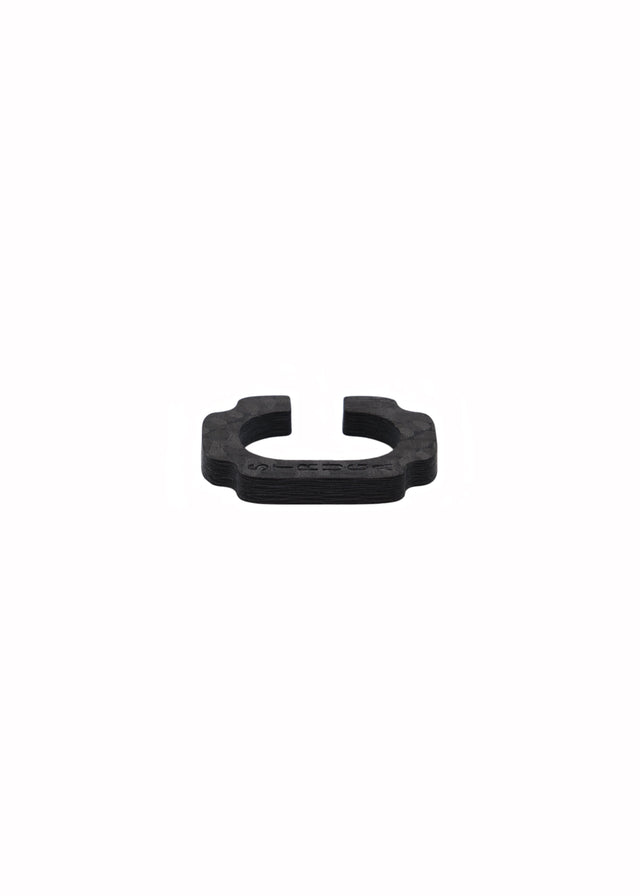
The third direction crosses sterling silver with multi-layered matte carbon fibre. The combination produces a contrast that no single metal can: silver that records the wearer beside carbon that refuses to record anything. The Carbon family includes pieces using all six STRUGA palettes — Classic Graphite for a baseline matte black, Arctic Graphite for a cooler tone, Bloody Graphite for the warm red-black register, and the rarer Aged, Fused Graphite, and Toxic palettes for couples who want a less standard tone. Carbon does not corrode, does not patinate, does not need maintenance. Silver does all three. A wedding band that combines them tells a useful truth about marriage as a long-term object: parts of it will mark and accumulate history, parts of it will hold a steady reference point against which the marking is visible.
Adjacent direction — Thorn Ring
For couples who want a single-direction band rather than a hybrid, the Thorn Ring sits at the boundary between the THORN family (angular, ribbed, organic) and BRUTALISM (heavy, monolithic, architectural). It is one of the brand's most photographed rings as a non-traditional wedding band. The ring is unisex by construction and reads the same way on a man's hand and a woman's hand — useful for couples who want matched pieces without size-scaling losing the form.
About STRUGA. STRUGA is a dark silver jewelry brand founded by Dmitry Strugovshchikov and Ekaterina Strugovshchikova, handcrafted with Balinese and international silversmiths. Every piece is 925 sterling silver, naturally oxidized or hand-patinated. The darkening is part of the design. It is a brutalist object that reacts and changes through contact with the environment and the wearer.