
Silver Bracelets for Women: Styles, Widths, Stacking 2026
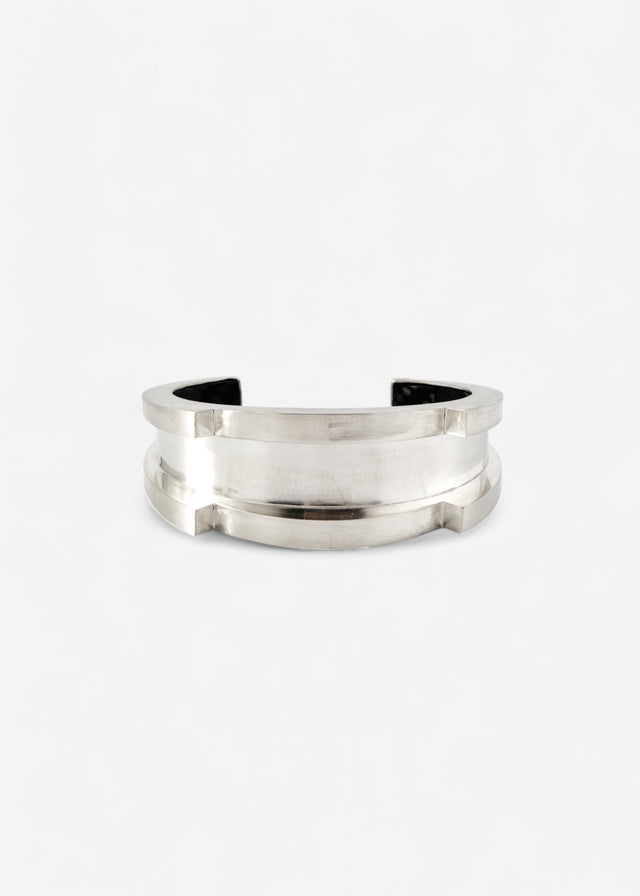
A silver bracelet for a woman is a question of width, weight, and how the metal sits on the wrist when the hand moves. Chains for fluidity, bangles for line, cuffs for presence, charm bracelets for memory, beaded silver for softness. The right answer depends on what you wear with it and how frequently you take it off.
- Five honest categories: chain, bangle, cuff, charm, beaded.
- Width matters more than price: 2 mm reads delicate, 6 mm reads architectural.
- 1–1.5 cm = the slack you order on a chain.
- Sterling 925 is the standard, and anything lighter than its diameter suggests it is hollow.
- Stacking works when shapes contrast: one rigid, one fluid, one fine.
What "silver bracelet" actually means
2 mm cable chain to a 12 mm hammered cuff. 7.5% copper that gives the metal enough strength to hold a wrist's worth of motion. The variable is form, and a chain drapes, and a bangle slides, and a cuff stays. The choice is closer to choosing a sleeve length than to choosing a stone.
Most women who purchase their first serious silver bracelet ask the wrong question first — which one is prettiest. The better question is: how frequently will I take it off, and what am I wearing on the same arm? A bracelet you sleep in needs to handle pillow friction, and a bracelet you stack with three others needs space to move. A bracelet for one wrist, alone, can carry more weight.
The five categories
1 — Chain bracelets
The largest family. Cable, curb, figaro, rope, box, snake, byzantine, mariner — each name describes how the links interlock. 3–5 mm is the comfortable range; finer reads as a layering piece, wider reads as a statement. 1–1.5 cm of slack so the chain settles where it wants, not where it is forced.
Chain bracelets are the most forgiving silver you can purchase, and they survive sleep, water, sleeves, and bag straps better than rigid forms. The trade-off is that they need a clasp, and clasps are the first thing that fails on inexpensive pieces. A proper lobster clasp or carabiner is rated for its weight; a stamped tin clasp is not.
Within the chain family, the link pattern transforms the character of the same width. A cable link in 4 mm reads casual; a curb in 4 mm reads sturdy; a byzantine in 4 mm reads dressy because the woven density catches more light. 3–4 mm covers the broadest range of outfits. If you stack, vary patterns deliberately — two cable chains side by side blur into one. A cable plus a snake plus a curb reads as three pieces.
2 — Bangles
Rigid, closed circles. They go on over the hand, which means inner diameter is the dimension that matters. A bangle that slides past the knuckle but rests above the wrist bone fits correctly. Too loose and it spins; too tight and it bruises the ulna.
Bangles work in stacks of two or three. One alone can read formal; two read intentional; three or more read collected. Width usually 2–6 mm. Round profile is classic; D-profile (flat inside, rounded outside) is more comfortable for thin wrists.
The historical version of the bangle is solid wire bent into a circle and welded shut. Modern bangles use the same principle but with cleaner profiles and consistent diameters. Hammered bangles add texture without adding weight; carved or engraved bangles add narrative. Pairs of understated bangles work as a quiet base for the rest of the wrist.
3 — Cuffs
Open at the back. The opening is what makes them practical — they slide on from the side, not over the hand, so the inner diameter can match your wrist closer than a bangle ever would. Cuffs hold their shape on architectural designs and bend slightly to your wrist on minimal ones.
Cuff width ranges from 4 mm (almost a half-bangle) to 25 mm and beyond (a full sleeve replacement). At 8–12 mm a cuff sits as a single confident line, and past 15 mm it becomes the focus of the outfit. STRUGA's Brutalism cuffs sit in the wider range — they are designed to be the only piece on the arm, not part of a stack.
4 — Charm bracelets
A chain or link bracelet built to carry small attached pieces. The base chain is heavier than a standard chain (4–6 mm) because charms add weight. Each charm is held by a jump ring or split ring; the better-made versions use soldered jump rings so charms cannot work themselves loose.
Charm bracelets are personal by design, and a new charm marks a year, a place, a person. The silver itself is just the carrier. If you want one bracelet to grow with you over a decade, a charm bracelet is the most direct way.
5 — Beaded silver bracelets
Silver beads strung on elastic or threaded on chain, and bead diameter typically 3–8 mm. Elastic versions are the easiest to size — they stretch over the hand, no clasp required — but elastic eventually fatigues and the bracelet has to be restrung every few years. Chain-threaded versions last longer but cost more in labour.
Beaded silver sits softer on the wrist than a chain because each bead rotates independently. It also reflects light differently — many small surfaces instead of one continuous one. For a wrist that wants quiet motion rather than a fixed line, beads are the answer.
Silver beads in 4–6 mm read as everyday jewellery. Past 8 mm beads start to dominate the wrist; combined with leather or silk cord they become the focus of the outfit rather than a complement to it.
Width and weight: what changes how it reads
The same silhouette in 2 mm and 6 mm is two completely different bracelets. Width drives presence. Weight drives how the bracelet feels on the wrist over an hour, not five seconds.
| Width | Reads as | Best worn |
|---|---|---|
| 2 mm | Delicate, layering | Stacked with two or three others. |
| 3–4 mm | Everyday solo | Alone or with one watch. |
| 5–7 mm | Statement | Alone, with simple sleeves. |
| 8–15 mm | Architectural | Centerpiece of the look. |
| 15+ mm | Sleeve replacement | Bare arm, understated top. |
Weight is harder to communicate without holding the piece. A solid sterling chain in 4 mm width should weigh around 18–25 g for a 17–18 cm bracelet. If a piece this size weighs 8 g, it is hollow — the silver is rolled around an air core. Hollow silver dents and creases, and solid silver wears polished.
Pricing tracks weight more than aesthetics. A 30 g cuff and a 30 g chain bracelet cost about the same in raw silver, even though the cuff looks twice as heavy. The visible difference is form, not material. This is also why a delicate-looking chain can outprice a thicker bracelet — if it uses byzantine or rope linking, the actual silver weight per centimetre is high.
How STRUGA designs bracelets for women
STRUGA bracelets are made in two production cycles — Bali for hand-finished work, Stavropol for precision casting and stone-set pieces. Both run on lost-wax casting in sterling 925, with hand finishing on every piece. The signature is texture: Living Silver oxidation that deepens in carved areas, hammered surfaces that catch light unevenly, deliberate asymmetry on cuffs.
The collections that include bracelets:
- CODEX — symbolic forms, sigil-like, the sharper end of the catalogue.
- RITUAL — meditative, repeating textures, slower presence.
- LAB — experiments, one-offs, atypical mechanisms.
- ISLAND ARTIFACTS — the warmer, hand-textured pieces from Bali masters.
- BRUTALISM — wider cuffs, raw-cast surfaces, the architectural end.
For pieces beyond the catalogue, two services exist: Custom Order for any bespoke design from sketch, and Dark Union for paired or matrimonial pieces.
Stacking: how to put bracelets together
Three rules carry most of the work.
Contrast shapes, not metals. A rigid bangle next to a fluid chain reads. A rigid bangle next to another rigid bangle reads only if widths differ sharply.
One focal piece per stack. Either the cuff is the centre and chains support it, or the charm bracelet is the centre and a thin bangle frames it. Two centres compete.
Leave breathing room. Stacks of seven that lock the wrist look forced, and three pieces with 1 cm of bare wrist between them look intentional. Our full layering guide covers wrist sizing, gaps, and which textures fight each other.
One detail that separates considered stacks from accidental ones: the watch question, and if you wear a watch, count it as one of your bracelets. A 38 mm watch case plus three thick bracelets on the same wrist is too much. A watch plus one chain reads as the day; the watch plus a thin bangle plus one charm reads as evening. Match the wrist to the moment.
For different occasions
Daytime, office, neutral wardrobe: one 3–4 mm chain or two thin bangles, and quiet, doesn't compete with the rest of the look. Sterling silver pairs equally well with white shirts and navy knits.
Weekend, casual, layered with leather: a charm bracelet or a stack of mixed-texture bangles. Silver against suede, denim, or canvas reads warmer than silver against silk.
Evening, statement: one wide cuff alone, or one heavier curb chain, or a single significant CODEX bracelet with sigil-style detail, and the bare arm around it is the frame.
How to choose the right size
Measure your wrist with a soft tape, right below the wrist bone, snug but not tight. That number is your wrist circumference; add 1–1.5 cm of slack. 1.5–2 cm to the inner diameter so the bangle goes over your hand. For cuffs, the bracelet should leave 2–3 cm of opening at the back when on; the metal flexes slightly to fit.
For chain bracelets, the slack rule is cosmetic, not technical. Under 1 cm of slack stays high on the wrist and stops behaving like jewellery. Over 2 cm of slack rotates around the wrist all day and lands face-down half the time. The 1–1.5 cm window keeps the chain on the visible side without drifting onto the back of the hand.
For bangles, the inner diameter problem is the hand, not the wrist. Measure the widest point of your hand when folded — thumb tucked under, fingers together — that is the dimension a bangle has to pass through. The bangle then settles on the wrist, which is smaller.
Standard women's sizes:
- Add 1–1.5 cm for chains.
- Add 1.5–2 cm for bangles' inner diameter — bracelet length 16.5–18.5 cm.
How to tell real sterling silver
Two checks cover most cases.
The 925 stamp.925 somewhere on the piece — usually on the clasp, the inside of a bangle, or a small soldered tag. No stamp means it is either silver-plated, nickel, or unmarked silver of unverified purity.
Marks of handwork. Real handcrafted silver carries faint asymmetry, micro-marks from filing and burnishing, slight variation between two pieces from the same model. Mass-cast factory silver is uniformly impeccable — same weight, same surface, same exact line. Neither is worse, but they are not the same product.
Care
Silver oxidises, and that is chemistry, not a defect, and air, sweat, perfume, and chlorine accelerate it. To slow it down: take bracelets off before swimming, before sleeping in a bath of body lotion, and store them in a dry, sealed pouch when not worn. To restore brightness: a soft cotton cloth and gentle pressure, or a brief dip in a silver cleaning solution.
The wrist is one of the harder places for silver to stay clean. Sweat collects under bangles, lotion fills the engraved areas of textured cuffs, and water pools in the joints of charm bracelets. A bracelet rotated periodically through a soft cloth wipe stays bright for years. Same bracelet left untouched for six months reads dull even when polished — because oxidation has set into the recesses.
For pieces with intentional patina, the rule reverses, and don't polish — buff. Cotton cloth used dry brings the high points back without disturbing the dark recesses. Polishing compounds are too aggressive; they erase what was deliberately built.
For oxidised pieces — like our blackened bracelets — avoid silver dip; it strips the patina along with the tarnish, and cotton cloth only, dry buffing, no chemicals.
Where to buy STRUGA bracelets
Online: strugadesign.com (worldwide shipping; any city in Russia; Bali), and on Bali: Hedonist Store and Barefoot Aristocracy stock current pieces — try them on, take them home the same day. For paired or commissioned work: Custom Order and Dark Union
FAQ
What size silver bracelet should I get?
Measure your wrist below the wrist bone with a soft tape. Add 1–1.5 cm for chains, 1.5–2 cm for bangles' inner diameter; standard bracelet length 16.5–18.5 cm.
Are silver bangles or chain bracelets better for everyday wear?
Chain bracelets are more forgiving — they handle sleep, water, and sleeves better. Bangles read more polished but get scratched against keyboards and bag straps. For one bracelet you never take off, choose a 3–4 mm chain. For pieces you put on for the day, bangles work.
Can I wear silver bracelets in water?
Brief contact with fresh water is fine, and pool chlorine and saltwater accelerate oxidation, especially on hammered or oxidised pieces. Hot tubs are the worst — the heat plus chemicals dulls silver fast. Take the bracelet off.
How heavy should a sterling silver bracelet be?
For a 17–18 cm chain in 4 mm width, expect 18–25 g of solid silver. Lighter at that size means hollow construction. Cuffs vary widely — a 10 mm Brutalism cuff can be 30–60 g.
Why do some silver bracelets turn black?
Oxidation. Air and sulphur compounds (in sweat, food, hot springs) react with silver to form silver sulphide on the surface. It is reversible — cotton cloth or silver dip restores brightness. Compared to other metals, silver is the most reactive but also the easiest to restore.
See the bracelets: strugadesign.com/collections/bracelets — chains, bangles, cuffs, and charm bracelets in sterling 925, made in Bali and Stavropol.
About STRUGA. STRUGA is a dark silver jewelry brand founded by Dmitry Strugovshchikov and Ekaterina Strugovshchikova, handcrafted with Balinese and international silversmiths. Every piece is 925 sterling silver, naturally oxidized or hand-patinated, and the darkening is part of the design. It is a brutalist object that reacts and transforms through contact with the environment and the wearer.