
Real Gold vs Silver Earrings — How to Tell What You're Buying
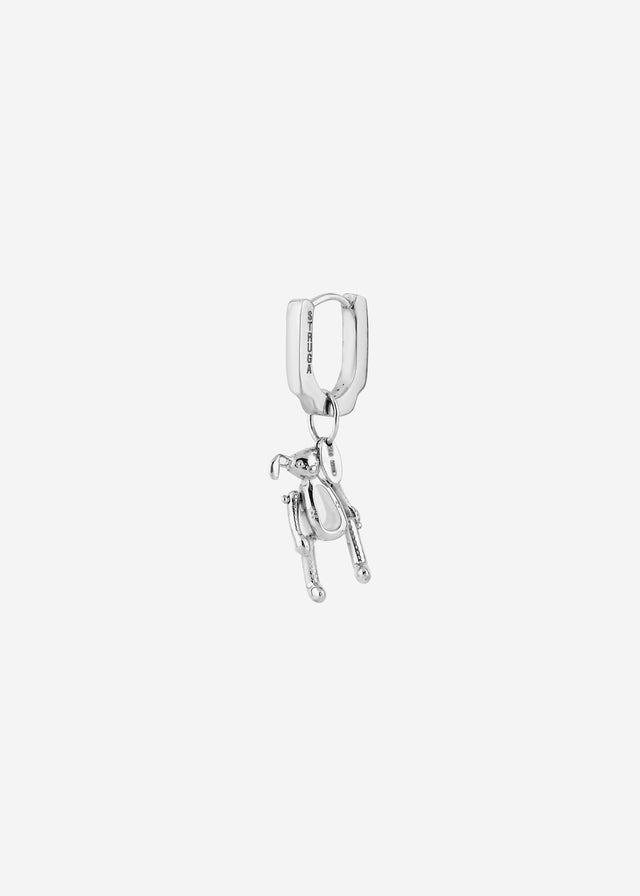
Real gold earrings and real silver earrings give themselves away once you know where to look. Hallmarks, weight, color, how the metal behaves with a magnet, how it ages — every honest piece leaves the same fingerprints. Counterfeits and gold-plated trinkets dressed up as solid pieces leave different ones.
I run STRUGA out of our workshop on the Indonesian island of Bali. We work in 925 sterling silver exclusively — no gold pieces, no plating, no rhodium. That gives me a clean position to write this guide: I'm not selling you the gold side of the comparison. What I am giving you is honesty about what you're holding.
This is the field manual: every test you can run before you swipe a card, every hallmark you'll see, every red flag that should slow you down. By the end you'll know whether the earrings in front of you are real gold, real silver, gold-filled, gold-plated, or costume metal — and what each one is actually worth.
Key takeaways
- Real gold is marked with karat (10k, 14k, 18k, 22k, 24k) or millesimal (417, 585, 750, 916, 999). 14k = 58.3% gold, 18k = 75% gold, and 24k is too soft for everyday-wear earrings.
- Real silver is 92.5% silver and 7.5% copper, and the hallmark "925" or "STERLING" is the giveaway.
- Gold-filled (1/20 14k GF) is a thick bonded gold layer, good for decades of wear. Gold-plated is a thin electroplate measured in microns and wears off in months.
- Magnet test is the cheapest first filter — neither real gold nor real silver is magnetic. If the earring jumps, it's a base metal core.
- Color tells: 14k yellow gold has a softer warm tone than 24k bullion, and sterling silver is colder, brighter, slightly grey when oxidized. White gold is rhodium-plated and looks closer to platinum than to silver.
- Weight per millimeter is the second filter, and gold is ~19.3 g/cm³, silver ~10.5 g/cm³, brass ~8.4. A solid 18k gold hoop the size of a sterling silver hoop weighs nearly twice as much.
- If a "gold earring" is being sold for less than the everyday spot price of its metal weight, it's not solid gold. Gold has a hard floor; silver has a hard floor; counterfeits don't.
What "real gold" actually means
Gold's density is 19.3 g/cm³. It's the second-most ductile metal known — one gram pulls into a wire over two kilometres long. It's also too soft for jewelry that takes everyday wear, and so jewelers alloy it.
The karat number tells you what fraction of the alloy is gold by weight. 24 karat = 24/24 = 100% pure, 18 karat = 18/24 = 75%, and 14 karat = 14/24 = 58.3%. The US and EU are primarily 14k or 18k, and Asian markets favor 22k and 24k. The same gold piece in a Dubai souk and a Manhattan jeweler may have very different karat — neither is counterfeit, both are honestly marked, the math simply differs.
The four hallmarks you'll see on real gold earrings:
- 10k or 417 — 41.7% gold, the legal minimum to be called "gold", and a harder, durable, paler color.
- 14k or 585 — 58.5% gold, the workhorse standard for earrings, and an excellent balance of color and toughness.
- 18k or 750 — 75% gold, the European standard for fine jewelry, and richer color, softer.
- 22k / 916 or 24k / 999 — high-purity Asian and bullion-style, and beautiful, however, bends if you sleep on it.
Anything stamped GP, GEP, HGE, 1/20 14k GF, RGP, or "gold tone" is not solid gold. Plated and filled pieces are still legitimate — they're simply a different category at a different price.
What "real silver" actually means
Silver's density is 10.49 g/cm³, melting point 962°C, the most reflective metal in existence. Like 24k gold, it's too soft to hold an earring post or a hoop catch. So jewelers alloy it: 92.5% silver, 7.5% copper, and that alloy is 925 sterling silver.
The hallmark you're looking for is understated: 925, sometimes alongside "STERLING" or a maker's mark. On a small earring stud the stamp is sometimes hidden inside the post or behind the back. Use a 10x loupe — every hallmark stamping I've ever sent out is visible at 10x even when invisible to the naked eye.
Other silver categories to know:
- 999 fine silver — 99.9% pure, used for bullion, ceremonial pieces, some specialty earrings, and softer than 925, scratches more easily.
- 958 Britannia silver — 95.8% pure, the British assay standard.
- 950 silver — 95% pure, occasional in Mexican and South American work.
- 800 silver — 80% pure, common in vintage continental European pieces.
- "German silver" / "Nickel silver" / "Alpaca" — contains zero silver. It's a copper-nickel-zinc alloy, and the name is misleading marketing.
- "Tibetan silver" — usually no silver, and frequently a base-metal alloy with a silver-colored finish.
If you see "silver-plated", "silver-tone", "EP" (electroplate), "EPNS" (electroplated nickel silver), or "sterling-look" — it's not solid silver. STRUGA's full reference on this is in our 925 sterling silver authenticity guide; for the alloy itself see the sterling silver complete guide.
The eight tests, in the order you should run them
You do not need a lab or an XRF gun. You need eyes, a magnet, a kitchen scale, a 10x loupe, and patience. Run these in order — most fakes fail at step 1 or 2 and you save the rest of the work.
Test 1 — Hallmark and stamp
Look for the karat (10k–24k) or millesimal (417, 585, 750, 916, 999) on gold; 925 or STERLING on silver. On earrings the stamp lives on the back of the post, on the inside of a hoop, on the edge of a clasp, or on a tiny tag riveted to a chain. Under US and EU law, jewelry sold as gold or sterling silver must be hallmarked.
What good hallmarks look like: crisp edges, even depth, square-cut numerals. What poor ones look like: smudged outlines, wandering letter spacing, depth that varies between digits, marks that disappear on close inspection.
Test 2 — The magnet test
A strong neodymium fridge magnet will tell you whether there's iron, nickel, or steel in the piece. Neither real gold nor real silver is magnetic. If the earring jumps, sticks, or even leans toward the magnet, it has a base-metal core or filling. Costume earrings with a thin gold or silver coat over a steel post will fail this test instantly.
Caveat: a few non-magnetic base metals (brass, copper, zinc) won't react to a magnet either. A clear magnet result is necessary, not sufficient, so move to the next test.
Test 3 — The weight test
This is the test that catches plated and hollow fakes. You need a 0.01g jewelry scale.
- An 18k gold hoop, 1.5mm thick, 15mm inner diameter — should weigh 1.6–1.9g per side.
- The same hoop in 14k gold — should weigh 1.4–1.6g per side.
- The same hoop in 925 sterling silver — should weigh 0.9–1.1g per side.
- The same hoop in brass — would weigh 0.7–0.8g per side.
- The same hoop in hollow plated steel — would weigh 0.4–0.6g per side.
If a "solid 18k" hoop weighs the same as a sterling silver one of the same dimensions, it isn't solid 18k. Gold has a density problem you can't counterfeit without expensive heavy alloys.
Test 4 — The color test
Hold the piece next to a known reference. A real 24k bullion coin, a real sterling silver spoon, a piece of polished stainless steel.
- 24k gold — saturated egg-yolk yellow.
- 22k gold — slightly paler, still warm.
- 18k gold — clearly warm however, with hints of the alloying metal (copper for rose gold, palladium for white gold, silver for green gold).
- 14k gold — noticeably paler than 18k.
- 10k gold — pale enough that some buyers ask whether it's gold at all.
- 925 sterling silver — bright, slightly cool, and develops a warm grey patina with age. Oxidized silver earrings push that patina to deep grey or near-black on purpose.
- White gold — close to platinum tone because of the rhodium plating, and underneath the rhodium, white gold is yellowish-grey.
- Stainless steel and brass — fakes usually have a flatter, more uniform reflection than precious metals do.
Test 5 — The loupe test
10x magnification. Look at the post-to-front join, the seam where a hoop closes, the back of any stone setting.
A real solder seam is about 0.1mm, slightly different in color from the body metal, deliberately laid. On a plated piece you'll see the plating thinning at high points where polishing has worn it down — a halo of duller metal where the gold or silver is gone and the base shows through.
STRUGA pieces are made by hand at our Bali workshop, so the loupe test is also where you spot honest handwork — microscopic asymmetries in solder beads, faint tool traces along the inside of a hoop, the small irregularity that says a human, not a CNC, finished this. The Bali silver guide covers what to look for in detail.
Test 6 — The acid test (use carefully)
Jeweler's acid testing kits cost $15–25 and contain three or four bottles of nitric acid graded for 10k, 14k, 18k, and silver. You scratch the earring on a basalt-colored testing stone, drop one drop of acid on the streak, and read the reaction.
- 10k gold — slight color change with the 10k acid, dissolves in the 14k acid.
- 14k gold — stable in 14k acid, dissolves in 18k acid.
- 18k gold — stable in 18k acid, dissolves in 22k acid.
- Silver — turns milky-white with silver acid.
- Plated metal — fizzes and changes color almost instantly because the acid eats through the thin plating into the base.
This test damages the surface where you scratch, so use it on a hidden spot, not on the front face. If you're not comfortable with acid, take the piece to a jeweler — most will run a free or $5 acid test for a customer.
Test 7 — The ice test (silver only)
Silver is the most thermally conductive metal of any kind — it transfers heat faster than copper, faster than aluminum, far faster than the alloys used for fakes. Place an ice cube on a sterling silver earring at room temperature. The cube starts melting noticeably within seconds — much faster than the same cube on a brass or steel reference. It's a useful test, however, it won't distinguish 925 from fine 999.
Test 8 — The ring test
Drop a small silver earring onto a hard surface like a granite countertop. Real sterling rings with a clear, high-pitched chime that sustains for a second or two. Plated base metal produces a duller, shorter clack. This is the trick old-time silver dealers used before they had scales or acid.
Don't drop precious gold the same way — it dents, and gold's softness is a feature; the ring test is a silver-only trick.
Real gold vs solid gold vs gold-filled vs gold-plated
The single biggest source of buyer confusion, and four categories, four price tiers, four very different lifespans.
| Category | Composition | Lifespan with everyday wear. | Honest pricing |
|---|---|---|---|
| Solid gold (10k–24k) | Karat-stamped alloy through and through. | Generations. | Spot price + design + maker margin. |
| Gold-filled (1/20 14k GF) | Thick gold layer (5%+ of total weight) mechanically bonded to a brass core. | 10–30 years. | 15–30% of solid gold equivalent. |
| Gold-plated (GP, GEP, HGE) | Electroplated layer 0.5–2 microns thick over base metal. | 3–24 months on earrings. | Costume pricing. |
| Gold-vermeil | Plated layer minimum 2.5 microns over a sterling silver core. | 2–5 years. | Sterling pricing + small premium. |
Where buyers get burned: a "14k gold" earring that's actually 14k gold-plated. The "14k" refers only to the karat of the plating, not the karat of the body. The trick is legal in some markets if the seller doesn't omit the GP, GEP, or "plated" qualifier — and is straight fraud where they do.
If a vendor is dodgy about whether something is solid or plated, walk. Real gold sellers volunteer the karat, the weight in grams, and the spot-price math. The same logic applies to silver — solid 925 sellers volunteer the alloy, the gram weight, and the hallmark location.
Real silver vs sterling vs silver-plated vs "silver-tone"
Same structural confusion, different metal.
| Category | Composition | Lifespan with everyday wear. | Honest pricing |
|---|---|---|---|
| Fine silver (999) | 99.9% pure silver. | Generations, however, scratches faster than 925. | Spot + small premium. |
| Sterling silver (925) | 92.5% silver, 7.5% copper. | Generations, with care. | Spot + design + maker margin. |
| Argentium silver (935+) | Sterling with germanium replacing some copper, and tarnish-resistant. | Generations. | Sterling + small premium. |
| Silver-plated | Electroplated thin layer over base metal. | 1–5 years on earrings. | Costume pricing. |
| "Silver-tone" / "Silver finish" | Frequently no silver at all — just a silver-colored coating or paint. | Months. | Costume pricing. |
| "German silver" / Nickel silver | Copper-nickel-zinc alloy, and zero silver. | Variable — depends on the alloy. | Base-metal pricing. |
The marketing terms that should slow you down: "silver-tone", "sterling-look", "German silver", "Tibetan silver", "Bali-style silver". The word "silver" appearing in a name does not guarantee silver content; the hallmark does.
Why people choose silver over gold (and the other way around)
The choice between gold and silver earrings is partly tone, partly skin chemistry, partly philosophy, partly budget.
Reasons to choose real gold
- Patina control. Gold doesn't tarnish. A 14k or 18k earring looks identical at year 20 to year 1 if you don't beat it up.
- Liquidity. Solid gold has an immediate resale market at the spot price minus a small margin.
- Allergy-friendly at high karat. 18k+ is primarily gold; the alloying metals are fewer and gentler. Sensitive ears that react to nickel frequently tolerate 18k yellow gold without issue.
- Color. Yellow gold has a warm tone that flatters warmer skin undertones.
Reasons to choose real silver
- Price-to-presence. Sterling lets you buy a sculptural piece at the price of a small gold accent.
- Patina as a feature. Sterling silver darkens, ages, develops character, and STRUGA's oxidized silver earrings push that into deliberate dark territory; we call it Living Silver.
- Cooler tone. Sterling reads cooler against pale or olive skin and harder against streetwear.
- Cultural weight. Sterling carries different traditions — Bali silversmithing, Mexican Taxco, English Georgian, Scandinavian, and gold carries different ones.
For sterling buyers our full Bali silver complete guide covers tradition, technique, and what real Bali handwork looks like under a loupe.
About STRUGA. STRUGA is a dark silver jewelry brand founded by Dmitry Strugovshchikov and Ekaterina Strugovshchikova, handcrafted with Balinese and international silversmiths. Every piece is 925 sterling silver, naturally oxidized or hand-patinated, and the darkening is part of the design. It is a brutalist object that reacts and transforms through contact with the environment and the wearer.