
Engagement Ring Guide: How to Choose in 2026
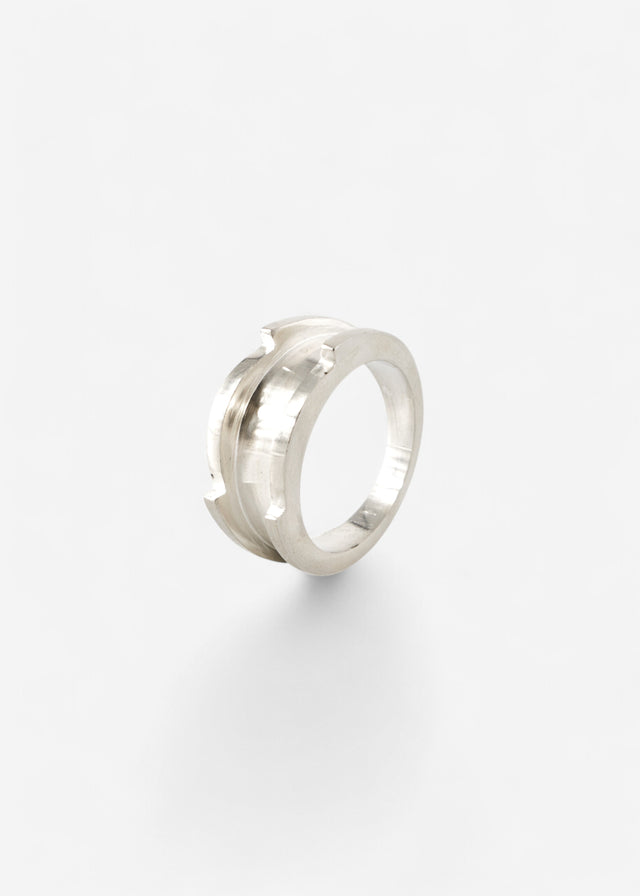
An engagement ring is the piece given at the moment of proposal — a worn mark of the intent to marry. The cultural template — a solitaire diamond on a high gold setting at $1,500–$15,000 — is younger than people assume. It crystallised in the second half of the twentieth century. Engagement rings exist in dozens of older traditions; today couples are increasingly rewriting the script. STRUGA makes engagement rings in oxidised 925 sterling silver, hand-cast in our Bali workshop at $180–$1,200, lead time 2–4 weeks. This is the complete guide: what an engagement ring is, how to choose the metal and form, how it differs from a wedding band, and why more couples drift away from the classical formula toward author design.
Key takeaways
- What it is: the ring given at the proposal — a symbol of the promise of marriage. The wearing finger varies by country (left hand in most of the West; right hand in much of Northern, Central, and Eastern Europe).
- Classic vs. alternative: mass-market is gold or platinum with a diamond ($1,500–$15,000). Author design — silver, alternative stones, or no stone at all ($180–$1,500) — with character and a story.
- Wearing finger: left ring finger in most of the West (US, UK, France, Italy); right ring finger in much of Northern and Central Europe (Germany, Austria, Norway, Poland).
- Sizing: measured as the inner diameter in millimetres. European size equals the millimetre diameter.
- STRUGA approach: every engagement ring is hand-cast in our Bali workshop in batches of 8–12. Oxidised 925 silver, no rhodium plating — Living Silver ages with the couple.
- Lead time: ready pieces ship in 3–5 days. Made-to-size or engraved adds 2–4 weeks. A Dark Union paired engagement-and-wedding set takes 3–6 weeks.
- Where to look: silver rings, the dark union service for paired sets, custom order service for a fully bespoke piece.
What an engagement ring is
An engagement ring is the piece worn between the proposal and the wedding. It marks the intent to marry: the couple is no longer simply together, but not yet married. The wedding can follow in a month or in two years; the ring stays on through the entire interval.
The current global template — a solitaire diamond on gold or platinum — settled into place in the twentieth century, propelled largely by a single advertising campaign. Engagement rings as a custom are far older. The ritual traces back to ancient Rome, where a groom gave his bride an iron ring as a symbol of contract. In medieval Europe the rings became gold. In 1477, Archduke Maximilian of Austria presented Mary of Burgundy with a diamond ring — the first historically recorded diamond engagement ring. (See Engagement ring on Wikipedia for the long-form history.)
The modern mass tradition is a fusion of an ancient ritual and a 1947 marketing campaign. Recognising both halves helps a couple choose freely rather than dutifully.
Engagement ring vs. wedding band — the difference
These are two distinct objects with different jobs.
An engagement ring is given at the proposal. Worn by one partner in the classical Western template. Design language: most often a solitaire centre stone in a high prong setting, or a cluster of small diamonds, or — in author work — a sculptural form. It's meant to be visible, to register as a deliberate gesture.
A wedding band is exchanged at the ceremony. Worn by both partners. Design language: smooth or minimally detailed, usually without a large stone. It's meant to disappear into daily wear — not to catch on clothing, not to demand attention, to outlast decades.
After the wedding the two rings often share a finger. In most of the West both rings live on the left ring finger, with the wedding band closest to the palm and the engagement ring outside it (the older folk reasoning being that the band sits "closer to the heart"). For paired-design thinking — engagement and band built as a single visual system from the start — see our complete dark wedding rings guide.
On which finger an engagement ring is worn
The wearing finger varies sharply by country. The shorthand:
- Left hand, ring finger: the United States, the United Kingdom, France, Italy, Spain, Portugal, Brazil, most of Latin America, Australia, Ireland. The convention traces back to a Roman folk belief that a vein — the vena amoris — ran from the left ring finger directly to the heart. The anatomy turned out to be wrong; the tradition outlasted the science.
- Right hand, ring finger: Germany, Austria, Norway, the Netherlands, Poland, much of Eastern Europe and the Balkans. In several of these countries the wedding band stays on the right after marriage and the engagement ring migrates to the left to avoid stacking.
- Mixed conventions: Greece and Armenia often run engagement on the left and wedding on the right, without later combining them.
The cross-cultural rule that applies everywhere: keep the ring on the same finger across the engagement. Switching hands midway between events runs into folk superstition in nearly every culture that maintains one. For a mixed-tradition couple, the choice is worth making early so the ring stays consistent.
How to choose an engagement ring — a step-by-step approach
Most guides start with "set the budget." That works for a mass-market diamond decision, where the question reduces to how much to spend on stone and metal. Author work runs a different sequence: first the wearer's character, then the form, then the material, and only then the price. The order below follows that logic.
1. Read what she already wears
Look at the jewelry already on her hand. Thin and minimal, or substantial and bold? Silver or gold? Geometric and contemporary, or classical and traditional? The answer matters more than any review-site ranking of stones.
If she wears jewelry every day, the ring needs to integrate with that existing language rather than fight it. If she rarely wears any, the engagement ring is a chance to set a new visual baseline — one piece that becomes the anchor of a small future collection.
2. Choose the metal
The realistic options:
- 14k or 18k yellow gold. Warm tone, the classical home for large white diamonds. Suits warm skin tones. Five to fifteen times the cost of a comparable silver piece.
- 14k or 18k white gold. A silvery tone, but raw white gold is slightly yellow — it gets rhodium-plated to brighten it, and the plating wears off after one to two years and needs reapplication. Platinum carries no such issue but costs more.
- Platinum. The densest and most wear-resistant of the fine jewelry metals. Doesn't tarnish, doesn't gain visible scratches at depth. 1.5–2× the cost of gold.
- 925 sterling silver. The same alloy used for sterling worldwide — 92.5% silver, 7.5% copper. Five to ten times less than gold for the same piece. Develops a patina from air and water; STRUGA oxidises silver deliberately into a deep graphite tone so the patina works with the design rather than against it. We call this approach Living Silver.
- Palladium, titanium, tantalum, carbon fibre. Alternative metals for couples who want to step away from the classical palette entirely. Carbon enters the STRUGA palette through the Carbon family — combined with silver, or used on its own. (See Sterling silver on Wikipedia for the alloy reference.)
3. Decide on a stone, or no stone
Classical: diamond. The strong alternatives — sapphire (blue or coloured), emerald, ruby, coloured tourmaline, morganite, aquamarine, moonstone, black spinel, onyx. Stoneless: the form of the ring itself becomes the focal element.
STRUGA's default for engagement work is no stone, or a small accent in a quiet part of the ring. The reason: a sculptural Brutalism silhouette or an asymmetric Signature Asymmetric architecture is already the centre of the composition; a centred diamond on top tends to read as overdone. When a stone is right, we set it as a deliberate accent rather than a focal point.
For couples who want a coloured stone with character — sapphire, emerald, black spinel, rutilated quartz — see the rings catalogue or open a brief through Custom Order.
4. Settle on a form and design language
STRUGA's design families that work as engagement rings:
- Blade — sharp, angular silhouettes; an edge that reads like a blade. For minimalists who want minimalism with intent.
- Signature Asymmetric — asymmetric architectural forms. Sculptural rings, visible from across a room.
- Signature Heart — forms with a circular cut-out or heart-shape as the meaning anchor. The closest the catalogue gets to romantic, without the kitsch.
- Brutalism — heavy, raw forms; a reference to the brutalist architecture of the 1960s. For couples whose aesthetic lives in simplicity and presence.
- Thorn — rings with a thorn or sharp detail. The darkest line, made for non-classical engagements.
If none of the families match exactly, Custom Order takes the brief and renders it.
5. Find the size
Ring size is the inner diameter in millimetres. The European system used in most of continental Europe matches that diameter directly: 16.5 mm equals size 16.5. The US and UK systems use their own tables.
The most accurate approach: take a ring she already wears on the intended finger and measure the inside diameter with a calliper. If no ring is available, wrap a paper strip around the finger (better while she sleeps), mark where the ends meet, measure the length, and divide by 3.14 to get the diameter.
For a surprise proposal where you can't ask, order a typical size (16–17 mm for women, 19–20 mm for men) with the option to resize. STRUGA offers one free resize after delivery, so a small mismatch is not a problem.
6. Set the budget — honestly
The old "two-to-three months of salary" formula came from the same 1947 De Beers campaign that made diamonds the default — it was a marketing line, not a guideline. (See A Diamond Is Forever on Wikipedia.) The honest budget is whatever fits without strain on the household. Spending below that line and proposing now beats years of saving for a "proper" ring.
Approximate ranges:
- $150–$500. Silver without a stone, or with a coloured accent (sapphire, spinel). Most of the STRUGA engagement catalogue lives here. Hand-cast, low-volume, character-forward.
- $500–$1,500. Silver with an accent diamond or coloured sapphire; or platinum/gold without a stone; or a custom silver commission.
- $1,500–$5,000. Gold or platinum with a small diamond (0.3–0.7 ct). Mid-market chain stores and entry-level work from independent jewelers.
- $5,000–$20,000+. Diamond from 1 ct up, heritage houses (Tiffany, Cartier, Harry Winston), or fully custom design with a high-end stone.
The price doesn't equal the strength of feeling. If the budget is $200, that's a real budget. The strongest $200 ring is the one that hits the wearer's character — not an imitation of a $2,000 ring. STRUGA's catalogue is built for that brief: silver, no pretence of being something else, with a defined visual identity.
How a STRUGA engagement ring is made
The process is consistent across the catalogue. A hand-built or 3D-printed model becomes a silicone mould; from the mould a wax replica is pulled; the wax is then cast in 925 silver; the rough silver is hand-finished — filed, oxidised, polished where it needs polishing. The detail — the precise edge of the oxidation, the depth of the surface texture, the readability of the solder line — depends on the maker's hand. Two rings cast from the same mould are never identical at the level of finish.
This is not romantic marketing. It's a tangible difference in how the object is made. A STRUGA silver ring at $400 carries a presence that a stamped chain-store band at the same price cannot match.
Worlds and families that house engagement rings
STRUGA engagement rings live across several worlds. Choose by aesthetic rather than category.
- CODEX — the foundation: Blade, Thorn, Signature Asymmetric, Signature Heart, Brutalism, Mosaic. Rings built for daily wear.
- RITUAL — pieces with symbolic content. The right home for an engagement ring that should feel ceremonial.
- LAB — small-batch experimental work, including pieces with rare materials like the Carbon graphite palette and Seymchan meteorite inlays.
- DARK UNION — the dedicated wedding-band line. Paired engagement-and-wedding sets designed as a single visual system from the start.
- Custom Order — for a stone, finish, or form that doesn't appear in any current piece.
Paired sets — engagement and wedding band as one system
If the proposal will be followed by a wedding (rather than left as an open-ended engagement), it is worth thinking about both rings together. STRUGA's Dark Union line is built for this: paired rings designed so the engagement and wedding sit together as a coherent visual pair on the same finger.
The Dark Union logic:
- The engagement ring carries the sculptural element — a cut, a thorn, a dominant texture.
- The wedding band stays smooth or carries one minimal detail and nests close to the engagement.
- Both rings come from a single design language — not "two different rings" but a diptych.
- The pair is conceived as his-and-hers from the start. They don't have to match exactly: the man's ring is often heavier and more brutal; the woman's is more refined; both belong to the same aesthetic.
Dark Union pricing: $300–$2,500 per pair. Lead time 3–6 weeks. The full-line walkthrough lives in our complete dark wedding rings guide.
Engagement ring without a diamond — the alternatives
The diamond became culturally mandatory only in the second half of the twentieth century after the De Beers campaign. The shift away from the diamond default is now well underway. The strong alternatives:
Sapphire. The hardest gemstone after diamond (Mohs 9 to diamond's 10). Comes in blue (the classic), pink, yellow, green, and white (colourless and visually close to a diamond). Princess Diana received a blue sapphire engagement ring in 1981 — Catherine, Princess of Wales, now wears it. Custom sapphire engagement rings are available through Custom Order.
Emerald. Deep green. Softer than sapphire (Mohs 7.5–8) — asks for careful wear: avoid heavy hand-work, avoid impact. Jacqueline Kennedy received an emerald engagement ring in 1953.
Ruby. Red corundum, sharing sapphire's hardness. Deep, saturated colour. Suits couples who want symbolic fire and intensity rather than classical clarity.
Coloured tourmaline, morganite, aquamarine, peridot. Semi-precious but visually striking. Morganite reads soft pink; aquamarine, pale blue; tourmaline, almost any colour. Less expensive than sapphire or emerald, equally valid aesthetically.
Moonstone, black onyx, black spinel. Non-classical stones. Moonstone carries a silvery-blue mystical sheen. Black onyx and black spinel sit deep black and pair perfectly with oxidised silver — a STRUGA-native combination.
No stone at all. Most STRUGA engagement rings ship without a stone. The form of the ring itself does the work — the Blade edge, the Signature asymmetry, the Thorn point, the Brutalism mass. The ring as a small sculpture.
Engagement ring pricing — by segment
Prices range widely, from about $50 to $50,000+. The drivers:
- Metal. 925 silver is the entry. 14k gold is 5–8× more for the same weight; 18k gold is another 30–40% above that; platinum is 1.5–2× gold. Carat weight of the stone stacks on top.
- Stone size and quality. A 0.3 ct diamond runs $300–$1,500. 0.5 ct: $1,500–$4,000. 1 ct: $4,000–$12,000. 2 ct: $15,000–$50,000+. Within a single carat weight, colour grade (D–H is preferred), clarity (FL–VS1), and cut quality (Excellent–Very Good) shift price dramatically.
- Brand. Tiffany, Cartier, Harry Winston, Graff carry a 2–4× markup over comparable work from independent jewelers. The markup pays for the box and the heritage, not the material.
- Production method. Mass production is the cheapest for a given metal-and-stone combination. Author work — STRUGA, independent ateliers — runs 30–80% above mass for the same material spec, and delivers different design and presence.
What the segments map to in practice:
- Up to $300: silver without a stone, or with a small accent. Most of the STRUGA engagement catalogue.
- $300–$1,000: silver with a coloured stone, or 14k gold without a stone, or a custom STRUGA piece.
- $1,000–$3,000: 14k gold with a small diamond (0.2–0.3 ct), or platinum without a stone, or a complex author commission.
- $3,000–$10,000: 0.5–1 ct diamond in gold or platinum. Entry-level Tiffany and Cartier.
- $10,000+: diamonds from 1 ct, named houses, custom designs with high-end stones.
The point that's worth keeping clear: price doesn't equal the strength of feeling. The $200 ring that fits the wearer's character outperforms the $2,000 ring that imitates a $20,000 one. STRUGA's catalogue is built for that exact brief — silver, no pretence, defined visual identity.
How to propose — a few practical notes
The ring is half the question; the moment is the other half.
Skip a public proposal unless the answer is certain. A restaurant-and-band proposal works if the answer is already known. Otherwise it lands as pressure, not romance.
Pick a place that means something to the two of you, not a place that photographs well. The strongest proposals happen where you met, where the first date landed, where something earlier was decided. Not in a generic scenic location borrowed from a feed.
Give the ring its own beat. Don't show the ring before the question — the question first, then the box. Natural order, not a marketing flowchart.
Choosing the ring together is fine. The surprise is optional. Many couples pick the ring as a pair and let the proposal happen later, in its own moment. The ring fits better and matches her aesthetic; the proposal carries the weight on its own.
Don't tie it to a date. Birthdays, holidays, and anniversaries crowd the proposal. The strongest moments often land on an ordinary day, with no other event sharing the air.
What to avoid
Avoid mass-market silver from chain retailers. Mass silver without character reads worse than mass gold — it carries the price of silver but none of the qualities (texture, handwork, oxidation, mass) that make silver worth wearing. Buy from named workshops.
Avoid white rhodium-plated silver. Plating that exists to "stop silver from darkening" wears off unevenly after two or three years and ends up looking worse than unplated silver. Choose oxidised or matte silver that ages on purpose.
Avoid very large stones in soft settings. Silver is softer than gold. A stone larger than 1 ct in a high prong setting can loosen over time. Bezel or flush settings minimise the risk; for very large stones, a hybrid silver-and-steel setting is the safer engineering choice.
Where to buy
Online: strugadesign.com with worldwide shipping from Bali. For paired engagement-and-wedding sets: Dark Union. For a fully custom commission — your stone, your form, your finish: Custom Order. Bali walk-in: Hedonist Store (Seminyak) and Barefoot Aristocracy (Canggu) for sizing and try-on.
Questions on a specific brief — the form to email is contact@strugadesign.com. Replies come from us, not a call centre, and any idea can be discussed at length before any decision to order.
Frequently asked questions
On which finger is an engagement ring worn?
In most Western countries (the US, UK, France, Italy, Spain, Brazil) it sits on the ring finger of the left hand. In Northern and Central Europe (Norway, Germany, Austria, the Netherlands, Poland) and across much of Eastern Europe and the Balkans it sits on the right. Greek and Armenian couples often reverse the convention. The single rule that applies everywhere: keep it on the same finger throughout the engagement.
What is the difference between an engagement ring and a wedding band?
An engagement ring is given at the proposal — typically with a centre stone or a sculptural author design. A wedding band is exchanged at the ceremony — typically smooth or minimally detailed so it sits comfortably with the engagement ring. The two are often worn together on the same finger after the wedding.
How much should an engagement ring cost?
Whatever can be spent without strain on the household. The two-to-three-months-salary line was a 1947 marketing slogan, not a guideline. Realistic range: $150 to $50,000+. Most couples spend $500–$3,000.
Is a diamond required?
No. Diamonds became culturally mandatory only in the second half of the twentieth century after the De Beers campaign. Common alternatives: sapphire, emerald, ruby, morganite, aquamarine, tourmaline, black spinel, moonstone — or no stone at all, with the form of the ring carrying the design.
Can I propose with a silver ring and add a gold one later?
Yes. A STRUGA silver engagement ring is a complete object on its own, not a placeholder. Some couples later add a gold or platinum wedding band; many keep the silver pairing for both rings. Either path is correct.
How do I find ring size without asking?
Take a ring she already wears on the intended finger and measure the inside diameter in millimetres with a calliper. If no ring is available, wrap a paper strip around the finger while she sleeps, mark where the ends meet, measure the length, and divide by 3.14. STRUGA offers one free resize after delivery, so small miscalculations are fixable.
What is STRUGA's lead time?
Ready pieces ship from Bali in 3–5 business days plus 7–14 days transit. Made-to-size or engraved adds 2–4 weeks. A fully custom commission via Custom Order takes 4–8 weeks. A paired Dark Union set takes 3–6 weeks.
Browse silver rings, the dedicated paired-sets line at Dark Union, or open a custom brief through Custom Order.
Continue from STRUGA catalog: