
Oxidized Silver — What It Is, Why It Matters, How It Ages
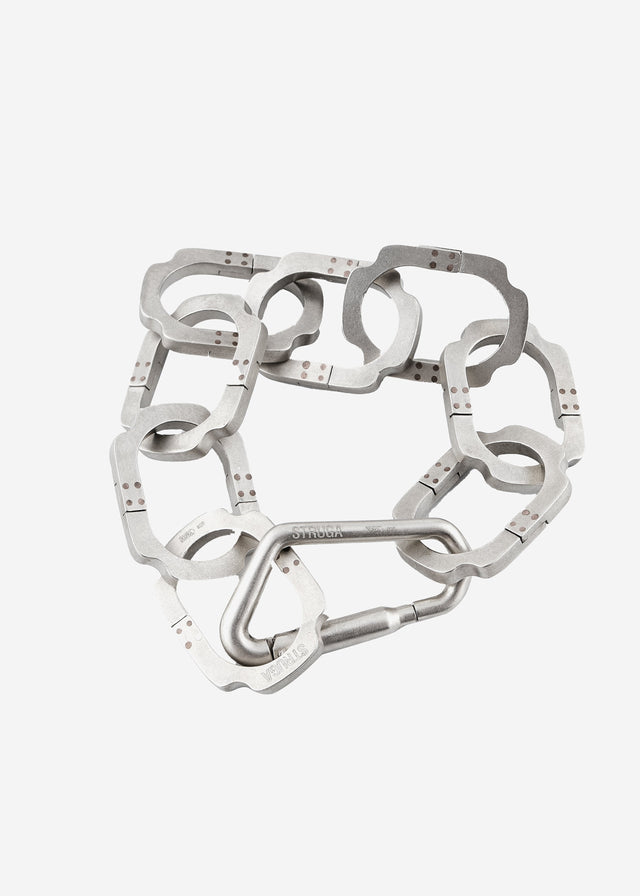
Oxidized silver is not damaged silver. It is silver that has been intentionally darkened through controlled chemistry — a thin layer of silver sulfide on the surface, dark grey to near-black, applied as part of the design. This guide explains what oxidation is, how it differs from natural patina, why some pieces are oxidized while others are left to develop their patina naturally, and how to live with oxidized silver across years of wear.
Key takeaways
- Oxidized silver = silver intentionally treated to form a dark surface layer (silver sulfide).
- The treatment is typically liver of sulfur (potassium polysulfide); other sulfur-based solutions exist.
- The dark layer is real silver chemistry, not a coating that wears off.
- Oxidized pieces age differently than non-oxidized ones — wear-points brighten faster, recesses stay dark longer.
- STRUGA uses oxidation strategically: some pieces oxidized, others left to develop natural Living Silver patina.
The chemistry of darkness
Oxidized silver is not «damaged» silver. It is silver that has undergone a deliberate, controlled chemical reaction — typically with liver of sulfur (potassium polysulfide) or other sulfur compounds — to produce a thin layer of silver sulfide on the surface. The result is a dark grey to near-black appearance, applied as part of the design rather than as a defect to be polished out.
The chemistry is the same as natural tarnish — silver reacting with sulfur to form Ag₂S. The difference is intentionality and control. Natural tarnish develops slowly and unevenly across whatever surface is exposed; oxidation is applied evenly, deliberately, and to a specific depth. For background, see the Wikipedia entry on silver sulfide.
Why oxidize silver?
Oxidation serves three design purposes:
- Contrast. Dark recesses make raised surfaces appear brighter, enhancing three-dimensional detail. A piece with intricate texture reads more clearly when the recesses are dark and the highlights bright.
- Depth. Oxidation creates visual depth that bright silver alone cannot achieve. The eye reads a darkened surface as having more dimensional character than a flat polished one.
- Aesthetic vocabulary. Dark silver belongs to a different visual world — industrial, gothic, architectural. The choice to oxidize signals which design language the piece is operating in.
How STRUGA uses oxidation
STRUGA employs two related approaches to dark silver:
Living Silver — natural patina
No intentional treatment at the workshop. The silver leaves the workshop with the cool grey of polished sterling and darkens naturally through contact with air, skin and moisture. Each piece develops its own unique patina pattern based on how it is worn, who wears it, and where on the body the contact happens. This is STRUGA's default approach for most wearable pieces. More on Living Silver →
Blackened — intentional oxidation
Applied in the workshop using sulfur-based patination. The artisan immerses or paints the solution onto the piece, watches the surface darken, and stops at the intended depth. Then they selectively remove the darkening from raised surfaces with fine abrasives, creating deliberate contrast. This finish is more dramatic and immediate than Living Silver — the piece arrives already dark. STRUGA's oxidized pieces, particularly in the Blackened Silver collection, take this approach.
How oxidized silver ages
Over time, the oxidized layer interacts with skin contact and ambient conditions. The piece does not stay frozen — it continues to evolve, but in a different way than untreated silver.
- Contact points brighten. Where skin touches the silver regularly — knuckles on rings, the underside of bracelet contact areas — friction wears through the surface darkening over months and exposes the brighter metal beneath.
- Recesses stay dark. Areas that don't contact skin retain their oxidation almost indefinitely. Crevices, undercuts, and back surfaces stay dark for years.
- The pattern is unique to the wearer. Two identical pieces oxidized in the same batch will look different after six months on different wearers. Hand chemistry, daily wear pattern, and frequency all affect how the brightening develops.
- Re-oxidation is possible. If the contrast fades too far for your taste, the piece can be sent back for re-oxidation. STRUGA offers this as part of lifetime refinishing.
Care for oxidized silver
- Gentle cleaning only. Aggressive polishing removes the oxidation, particularly from intentionally darkened recessed areas.
- No silver-dip solutions. Commercial silver dips strip all darkening — designed for bright-finish pieces only. Will permanently remove intentional oxidation from the recessed areas.
- Selective polishing only. Use a polishing cloth on the highlighted bright areas if you want to refresh contrast, but never on the recessed dark areas.
- Re-application possible. If the darkness fades unevenly, any competent silversmith can re-apply liver of sulfur to restore the original character. Ask the maker first if there is a specific oxidation depth they used.
- Avoid pool and ocean water. Chlorine and salt water accelerate uneven wear on oxidized surfaces.
Oxidation vs. plating — the key difference
| Property | Oxidation | Black plating |
|---|---|---|
| Material | Silver sulfide (real silver chemistry) | Black rhodium or ruthenium plating |
| Application | Chemical treatment | Electroplating |
| Depth | Microns into the surface | Microns on top of the surface |
| Wear behavior | Wears through gradually, exposing bright silver | Wears through patchy, exposing white silver |
| Re-application | Any silversmith | Specialist plating service |
| Authenticity | Real silver throughout | Different metal on top |
Oxidation is the design choice that sits inside the silver tradition; black plating is a coating applied on top of the silver. STRUGA uses oxidation, not plating.
Frequently asked questions
Will the oxidation rub off?
Yes, gradually, on contact points. This is the design — high-contact areas brighten while recesses stay dark. The result is sculptural contrast that develops with wear. The piece does not «lose» its oxidation; it gains a wear pattern.
Can I have an oxidized piece re-darkened?
Yes. Most silversmiths can re-apply liver of sulfur. STRUGA offers this as part of lifetime refinishing. Costs $20–$60 typically.
Is oxidized silver a real 925?
Yes — completely. Oxidation is a surface treatment of real 925 sterling silver. The silver itself is unchanged; only the surface chemistry differs from a polished piece.
Why does my oxidized piece look different from someone else's identical piece?
Skin chemistry, wear pattern and time. The same piece on different wearers develops different brightening patterns. This is intended — the piece becomes recognizably the wearer's over time.
Can I oxidize silver at home?
Possible but not recommended without knowledge. Liver of sulfur is available in art-supply stores; the technique requires careful timing to avoid over-darkening or uneven application. For an existing valued piece, send it to the maker rather than experimenting.
What if I prefer the bright look?
STRUGA also produces non-oxidized pieces — Living Silver in its bright state, allowed to develop natural patina slowly. Choose by collection: oxidized pieces are clearly identified as such.
Does oxidation make silver more allergenic?
No. The oxidized layer is silver sulfide — same skin compatibility as untreated 925. STRUGA's alloy is nickel-free regardless of finish.
Related
- Why silver tarnishes — the chemistry
- The Living Silver philosophy
- Blackened silver — STRUGA's dark side
- Living Silver vs rhodium-plated
- How to care for sterling silver
- Oxidized silver collection
- Blackened silver collection
STRUGA oxidation as design. Most STRUGA pieces use either intentional oxidation (Blackened collection) or natural Living Silver patina. Either way the metal is real 925 throughout; the dark surface is silver chemistry, not coating. The piece evolves with the wearer rather than freezing at the moment of purchase.