
How to Stack Silver Rings — Layering Guide for Men and Women
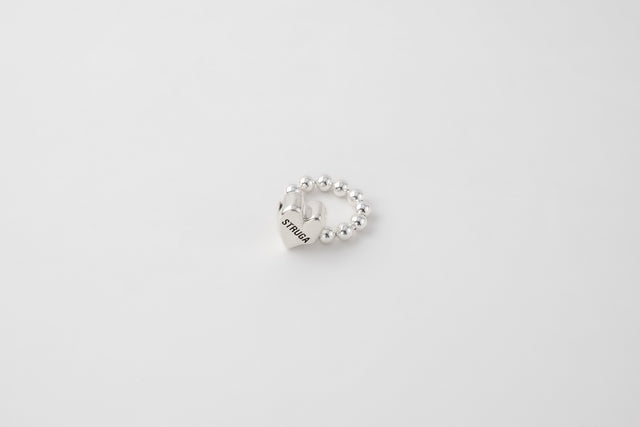
A silver ring stack works when each ring has a job. Width sets the rhythm, finish sets the contrast, and the finger decides what the stack actually says. The rule is simple: one anchor, one or two supporting rings, one detail. Mix oxidized with polished, vary the width, and stop adding before it looks busy.
TL;DR
- A stack needs one anchor ring (6–10 mm), one or two mid-width supports (3–5 mm), and optionally one detail ring (1–2 mm or textured).
- Mix finishes — oxidized next to polished reads better than three matte rings or three shiny rings.
- Per finger: two to three rings is the comfortable maximum, and four is statement territory and rarely works on small hands.
- Spread across the hand: don't pile everything on one finger, and index, middle, ring, pinky each carry a different weight.
- Check authenticity on every piece: 925 hallmark inside the band and visible signs of handwork.
- Men and women follow the same logic — width, finish, contrast, and the archetypes differ in scale, not in rules.
What is a silver ring stack, really?
A ring stack is more than one ring worn together — usually on the same finger, sometimes spread across adjacent fingers, sometimes both. The point is composition. You are building a small sculpture on your hand, and the rings have to talk to each other.
Most people start a stack by accident. One ring becomes two, two becomes four, and at some point the hand stops reading as styled and starts reading as cluttered. This guide is the structure I wish someone had given me before I owned forty rings.
The rules below apply to silver stacking rings in any style — minimalist, brutalist, signet, ornamental, and they are not about taste. They are about how the eye reads metal on a hand.
The three roles in any stack
Every working ring stack has three roles. Not every stack uses all three, but no stack works without at least two of them.
The anchor. The widest, heaviest, most visually loud ring, usually 6–10 mm, and it defines the silhouette and tells the eye where to land first. In our catalogue, anchors come from the Brutalism Rings collection or the wider Thorn and Blade pieces.
The support. A mid-width ring (3–5 mm) that frames the anchor — a plain band, subtle texture, or a slim signet. Its job is to give the anchor a base to sit on and keep the stack from looking like a single fat ring.
The detail. A thin band (1–2 mm) or a small ornamental piece, and the detail adds texture or a finish shift. It is the punctuation mark of the stack — a comma between two heavier statements.
If you only have two rings, run anchor + support, or anchor + detail. If you have three, all three roles. Four rings on one finger is the ceiling, and at four you need very precise width control.
How wide should each ring in a stack be?
Width is the most under-discussed variable in ring stacking. People talk about finish and design, but the eye reads width first.
The working principle: vary the width by at least 2 mm between adjacent rings. Two 5 mm bands stacked together blur into one 10 mm visual block. A 7 mm band next to a 3 mm band reads as two distinct objects. The contrast is what makes the stack legible.
For total stack height per finger, the comfortable range is 10–15 mm of vertical metal. A 6 mm anchor + 4 mm support + 2 mm detail = 12 mm. That fills the lower phalanx without crowding the knuckle. Above 18 mm and the ring stops bending with the finger and starts resisting it.
If you are new to stacking, start with one anchor and one detail. Skip the middle width entirely, and the contrast is sharper and the stack is harder to get wrong.
How to mix oxidized and polished silver
This is where most stacks succeed or fail. Three polished rings together look like you forgot to finish the outfit. Three oxidized rings together look like a costume; the mix is what creates depth.
Our rule of thumb: at least one oxidized piece and at least one un-oxidized piece in any stack of three or more. The oxidized ring sinks into shadow; the polished or raw 925 catches light. The eye moves between them, which is what makes a stack feel alive instead of static.
STRUGA pieces are 925 sterling with no rhodium plating — what we call living silver overview. The polished surfaces will tarnish naturally over weeks, and the oxidized surfaces will lighten in friction zones. Over a year, a stack of two rings worn everyday becomes a record of how you use your hand. That patina is the point, not a defect.
If you want everything to stay mirror-bright, this is not the right system. You'd need to clean every piece regularly — look at how to clean a silver ring and the oxidized silver care notes for the actual maintenance reality.
Finger logic — Which rings go where
The hand is not a flat surface. Each finger carries a different visual weight, and a working stack uses that.
Index finger. Authority finger, and carries the loudest ring well — wide, textured, unusual silhouette. If you wear only one ring, the index is where a brutalist anchor lands hardest. Stacks of two work; stacks of three start to crowd because the index is usually the largest finger after the thumb.
Middle finger. The largest finger, the most forgiving, and stacks of three rings sit comfortably here. The middle is also where most signet rings traditionally live — look at our silver signet rings page for the format.
Ring finger. Historically tied to commitment, increasingly worn freely. The ring finger is slimmer than the middle, so anchors here should be 1 mm narrower than what you'd put on the middle. Good for two-ring stacks: a band plus a detail piece.
Pinky. The classic signet finger, and a small detailed piece reads strongest here. Stacking two narrow rings on the pinky works; three is almost always too much.
Thumb. Unconventional, increasingly common in men's styling, and the thumb takes wide flat bands well — 8–12 mm. Don't stack on the thumb — one ring, no support.
The full hand strategy: spread. Two rings on the middle, one on the index, one on the pinky reads better than four rings on the index alone.
How many rings is too many?
Per finger, three is the working maximum, four is the absolute ceiling. Per hand, six rings is loud but works on most hands; eight starts to look like a costume unless the rings are deliberately tiny.
Two hands with three rings each is a balanced, lived-in look. Both hands fully stacked is a deliberate aesthetic statement that needs the rest of the outfit to match the volume.
The honest test: take a photo of your hand from arm's length, and if you can immediately count the rings, the stack is working. If they blur into one mass of metal, you've added too many.
Stack archetypes for women
These are working blueprints, not prescriptions, and adjust to your hand size and what you actually own.
The minimal stack. Two rings, same finger — a band plus a 5 mm detail piece. Reads as intentional, not jewelry-heavy. Works under shirt cuffs, in offices, around food; pull from dark minimalist rings for the base.
The architectural stack. Three rings on the middle finger. Anchor (6 mm Brutalism band, oxidized) + support (3 mm plain 925) + detail (2 mm textured). Total height around 11 mm. The contrast between the textured anchor and the polished support does most of the work.
The distributed stack. Four rings, three fingers — index: one wide signet; middle: two thin bands stacked; ring finger: one delicate piece. Reads as styled across the hand instead of piled on one knuckle.
The all-dark stack. Three oxidized rings on the middle, all from the same family — for example three pieces from the oxidized silver collection. This breaks the mix-finishes rule on purpose, and it works because the textures vary even though the colour is uniform. Advanced move; do not start here.
For more options, the jewelry for women overview shows what fits these blueprints.
Stack archetypes for men
Men's stacks follow the same width and finish rules but typically run wider. The hand carries more bone and more skin, so 8 mm reads as medium where on a smaller hand it would dominate.
The first stack. Two rings, different fingers. A wide brutalist anchor on the middle (8 mm) + a small signet on the pinky. This is where most men start without realising they've started stacking. Build from mens silver rings and the first ring guide.
The brutalist stack. Three rings on the middle finger. 8 mm Brutalism anchor + 4 mm Blade band + 2 mm thin detail. All in oxidized 925, with the polish coming from natural wear on the anchor's high points after a few weeks.
The thumb-and-stack. Wide flat band on the thumb (10 mm) + two-ring stack on the opposite hand's middle finger. The thumb ring acts as visual counterweight, and is common in our male customers in their thirties.
The full hand. Five rings across one hand: thumb, index, middle (×2), pinky, and it needs committed styling. Works for performers, creative professionals, and anyone whose work doesn't involve constant handshakes. Not a beginner stack.
The men's silver rings guide covers the underlying logic if you want it slower.
Mixing design families in one stack
STRUGA has eleven design families, and mixing them is allowed, even encouraged, but with a constraint: two families per stack maximum. Three or more and the stack stops reading as a composition and starts reading as a sample tray.
Combinations that work:
- Brutalism + Blade — both architectural, different textures.
- Thorn + plain band — organic spines need a flat surface to push against.
- Signature Asymmetric + Classic Amulet — the asymmetric piece is the focus, the amulet adds weight without competing.
- Mosaic + Carbon — both surface-driven, both restrained in silhouette.
Combinations to avoid in the same stack:
- Two ornamented families together (Thorn + Mosaic) — they fight for attention.
- Signature Heart + Signature Asymmetric — both are statement pieces, both need silence around them.
If you want to see the families in context, the CODEX rings collection is the cleanest entry point.
Common ring stacking mistakes
Same width, same width, same width. Three 4 mm bands stacked look like one 12 mm band that someone forgot to weld. Always vary by 2 mm.
All polished or all oxidized at three+ rings. Without finish contrast the eye has nothing to grip, and the stack flattens into a single tone.
Sizing the support rings the same as the anchor. Stacks ride differently depending on whether rings are loose or snug. The anchor should be your true size; supports can be a quarter size up to slide over the anchor and rest on top. Look at sizing guidance for measuring.
Forgetting the knuckle. A stack that fits the lower finger may not pass the knuckle when you take it off. Knuckles are typically a half-size larger than the base of the finger. If your support rings are too tight at the knuckle they'll never come off, and that's a problem when you need to clean them.
Stacking on the dominant hand for everyday work. If you type, lift, cook, or grip tools all day, heavy stacks on the dominant hand grind against each other. Put the loud stack on the non-dominant hand, and the dominant hand gets one ring, low-profile.
Buying matching sets. Pre-matched stacking sets from chain retailers look uniform but read as costume. A real stack is built one ring at a time, over months. Each piece earns its place because you bought it for itself, not as a third of a set.
How to check a silver ring is real before stacking
Stacking concentrates value on one hand. Before you commit to a stack, every piece in it should pass two checks.
The 925 hallmark. 925, or sterling, and no hallmark means no guarantee of the alloy. Some genuinely handmade pieces from older traditions skip the stamp, but for any new purchase the hallmark is non-negotiable.
Visible signs of handwork. Microscopic asymmetry in the band thickness. Tool traces — small file marks, faint texture lines — visible under good light or a 10× loupe. Solder points where the band closes or where ornament joins the shank. A piece that is mathematically perfect on every axis is machine-cast and machine-polished. That's not necessarily inferior, but it's not handcraft.
For the longer version of authenticity, look at the sterling silver — full guide. For the philosophy of why we don't plate, the silver as the new gold piece is the context.
How to build a stack from scratch
If you own zero rings and want to end up with a working three-ring stack, here's the order:
Buy the anchor first. Spend the most here. This is the ring you'll wear alone for two months while you decide what comes next. Pick something from Brutalism rings or whichever family hits hardest, wear it everyday, and notice how it patinas.
Add the detail second, not the support. A 1–2 mm thin band as the second ring lets you experiment with stacking without committing to a full three-ring composition. If you decide stacking isn't for you, the thin band still reads on its own.
Add the support last. By now you know whether you want symmetry or contrast, oxidized or raw, polished or textured. The support is the deliberate piece, and it completes the stack instead of starting it.
Total time from first ring to finished stack: three to six months if you're patient, two weekends if you're not. Patience makes better stacks.
About STRUGA. STRUGA is a dark silver jewelry brand founded by Dmitry Strugovshchikov and Ekaterina Strugovshchikova, handcrafted with Balinese and international silversmiths. Every piece is 925 sterling silver, naturally oxidized or hand-patinated, and the darkening is part of the design. It is a brutalist object that reacts and transforms through contact with the environment and the wearer.